Rodler’s Fine, Useful Booklet

rodler01.jpg

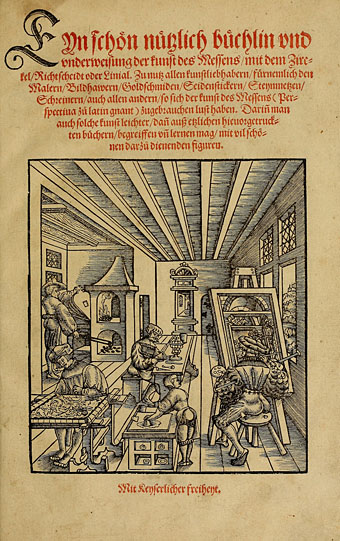
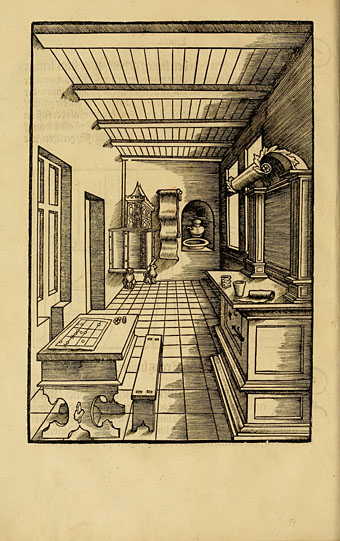
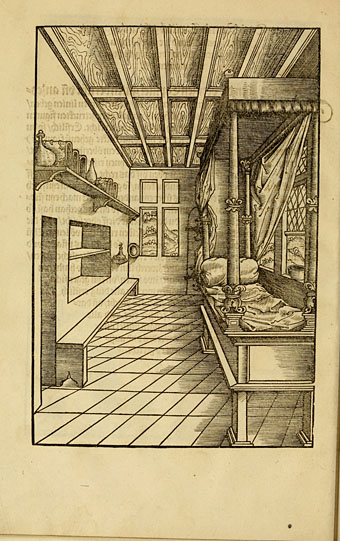
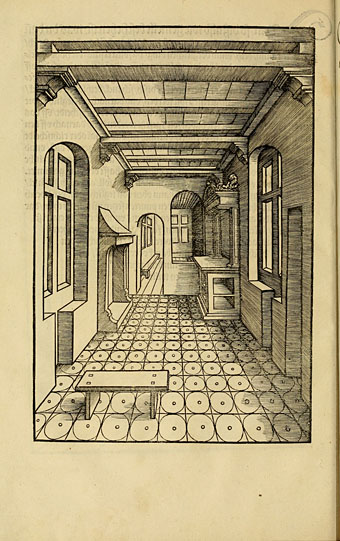
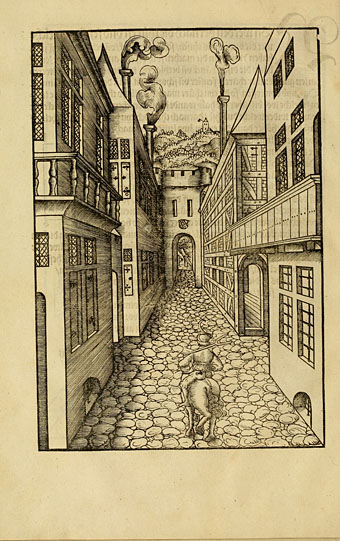
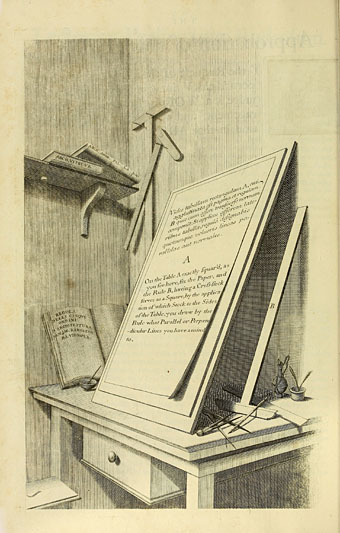
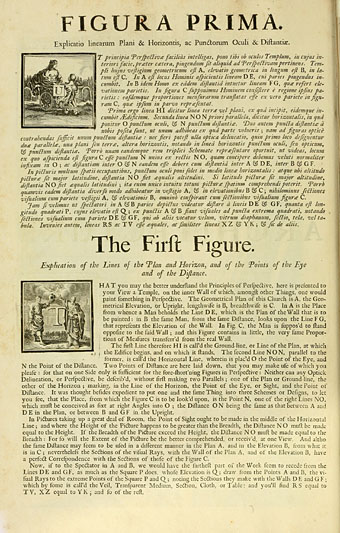
Another treatise on perspective, and an older one than Pozzo’s so the drawings are somewhat cruder. Eyn schön nützlich büchlin und underweisung der kunst des Messens (A Fine, Useful Booklet and Instruction in the Art of Measurement) by Hieronymus Rodler was published in 1531, and features a number of full-page views where the perspective is accurate but also alarmingly severe in places. The emptiness and unusual appearance of the scenes has an unintentional charm, they remind me of the illustrations from The Dumas Club (1993) by Arturo Pérez-Reverte where the mysterious drawings—based on old alchemical illustrations—contain subtle variations. Rodler’s book made an appearance at Giornale Nuovo in 2005 so I’ll point you there for further discussion of its technical qualities. The book itself may be browsed here or downloaded here.

rodler02.jpg

rodler03.jpg

rodler04.jpg

rodler05.jpg

Continue reading “Rodler’s Fine, Useful Booklet”

Rules and Examples of Perspective Proper, 1693

perspective01.jpg

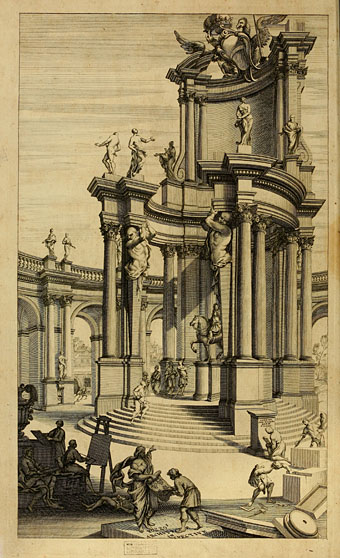
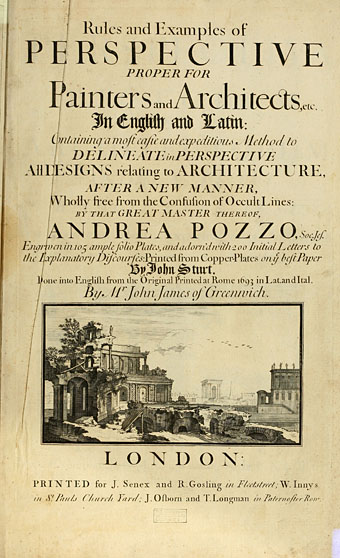
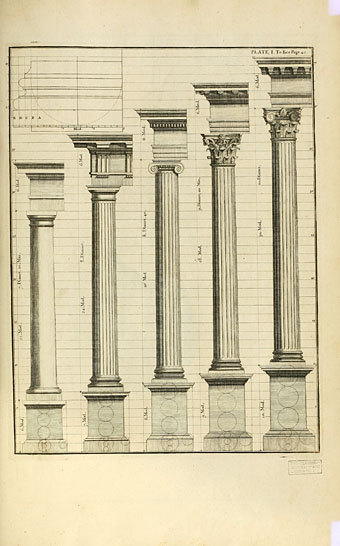
I’m working on more engraving collage at the moment so I’ve been delving into the scanned books at the Internet Archive once more in search of raw material. I still tend to use things scanned from paper volumes but the Internet Archive is useful for small details, and searches there also have the advantage of turning up things you might not otherwise see. This is one such book, an English guide to perspective for painters and architects adapted from the two-volume Perspectiva pictorum et architectorum by Andrea Pozzo (1642–1709). The title page declares the instruction to be “wholly free from the confusion of occult lines” which it certainly is, the plates would still serve as guides to the trickier aspects of perspective today. The engravings in this edition are by John Sturt.

Pozzo was a master of trompe l’oeil painting, and when you see ceilings such as this it’s no surprise that he might have a thing or two to say about perspective. The plates begin with simple shapes then graduate to the construction of the columns and capitals used in Classical architecture; at the end you have some intimidatingly complex pediments and porticoes. The University of Heidelberg has copies of Pozzo’s original books, including the second volume where things become even more elaborate.

perspective02.jpg

perspective03.jpg

perspective04.jpg

perspective05.jpg

Continue reading “Rules and Examples of Perspective Proper, 1693”

Tresham’s Trinities

lodge.jpg

Memorials of Old Northamptonshire (1903), a book edited by Alice Dryden, includes an entire chapter by M. Jourdain about Thomas Tresham’s Triangular Lodge. Descriptions of the building usually skate over the Catholic symbolism encoded in its structure but Jourdain goes into some detail describing the many inscriptions and numerological details. The engraved illustration is rather good as well, although it makes the lodge appear a more squat than it should be. The chapter also contains a description of further symbolism at Tresham’s Lyveden manor. Read it here.

Previously on { feuilleton }
The Triangular Lodge again
The Triangular Lodge

The Triangular Lodge again

temples.jpg

Artwork & photography by Abbie Stephens, Zoë Maxwell. Design by Thomas Caslin.

Passing through a record shop the day after looking at photos of the Winchester Mystery House I couldn’t help but notice this sleeve for the debut album by British band Temples. Yesterday I described Sarah Winchester’s house as a folly, which it is, but it was also her home. The ideal folly is an ostensibly purposeless structure, although many of the ones scattered around the UK do serve some kind of decorative function, often as fake ruins intended to be seen from a distance.

Thomas Tresham’s mysterious Triangular Lodge near Rushton, Northants, has always been a favourite, a small triangular building constructed in the 16th century, and encoded all over with references to the number 3. Tresham was a Catholic at a time when the faith was persecuted in England so the lodge is an expression of his devotion to the Holy Trinity. Given the unusual appearance of the building you’d think it might have appeared on an album cover before now. Temples are from Kettering in Northants so they can claim some local attachment to the place. The cover picture has something of a Hipgnosis look to it, which is no bad thing, and there’s also some Hipgnosis-style collaging at work; those trees in the background have been copied then flipped over. One benefit of the current vinyl resurgence is that sleeve designs like this aren’t spoiled by being only seen at CD size. Some of Temples’ songs can be heard on their SoundCloud page, while Pinterest has more views of the Triangular Lodge.

Elsewhere on { feuilleton }
The album covers archive

Previously on { feuilleton }
The Triangular Lodge

The Winchester Mystery House

winchester1.jpg

Winchester House, 525 South Winchester Boulevard, San Jose, Santa Clara County, CA.

“One of the peculiar traits of Hill House is its design—”

“Crazy house at the carnival.”

“Precisely. Have you not wondered at our extreme difficulty in finding our way around? An ordinary house would not have had the four of us in such confusion for so long, and yet time after time we choose the wrong doors, the room we want eludes us. Even I have had my troubles.” He sighed and nodded. “I daresay,” he went on, “that old Hugh Crain expected that someday Hill House might become a showplace, like the Winchester House in California or the many octagon houses; he designed Hill House himself, remember, and, I have told you before, he was a strange man. Every angle”—and the doctor gestured toward the doorway—”every angle is slightly wrong. Hugh Crain must have detested other people and their sensible squared-away houses, because he made his house to suit his mind. Angles which you assume are the right angles you are accustomed to, and have every right to expect are true, are actually a fraction of a degree off in one direction or another. I am sure, for instance, that you believe that the stairs you are sitting on are level, because you are not prepared for stairs which are not level—”

They moved uneasily, and Theodora put out a quick hand to take hold of the balustrade, as though she felt she might be falling.

“—are actually on a very slight slant toward the central shaft; the doorways are all a very little bit off centre—that may be, by the way, the reason the doors swing shut unless they are held…”

The Haunting of Hill House (1959) by Shirley Jackson.

I re-read Shirley Jackson’s novel a few months ago but neglected at the time to follow-up the reference to the Winchester House. News this week that Sarah Winchester’s sprawling folly in San Jose is to finally allow overnight stays prompted some investigation. The most remarkable thing about the Winchester Mystery House is that it’s much more of an oddity than its fictional relation, if you overlook (so to speak) the fact that Shirley Jackson’s house is a home to malevolent spectres. Sarah Winchester was heir to the Winchester rifle fortune, and instituted a process of continual and completely uncoordinated house-building for thirty-seven years, believing that this would confound the ghosts of those killed by the weapons bearing her name. Among the house’s 160 rooms are extraneous chambers and closets, doors to nowhere, and stairways serving no purpose. The spirit-trapping decorations include repeated spider-web motifs, and a recurrence of the number 13; one room at least was originally a Séance Room. This blog post concerns a tour round the house as it is today, while the Library of Congress has a number of views of the place.

winchester2.jpg

View looking west from top floor.

It’s unfortunate that the house was built in California’s earthquake zone, the structure had reached seven stories until the 1906 earthquake forced the removal of the three topmost floors. I had to go looking for views of the pre-quake building, and happily there are a few preserved on old postcards. When Blue Öyster Cult chose Adolph Sutro’s Cliff House for the cover of their Imaginos album they certainly picked the more immediately photogenic building, but the Winchester Mystery House a few miles to the south has it beat when it comes to metaphysical cachet.

The Winchester Mystery House at Pinterest.

winchester4.jpg

winchester3.jpg

Previously on { feuilleton }
The Cliff House revisited
Adolph Sutro’s Gingerbread Palace