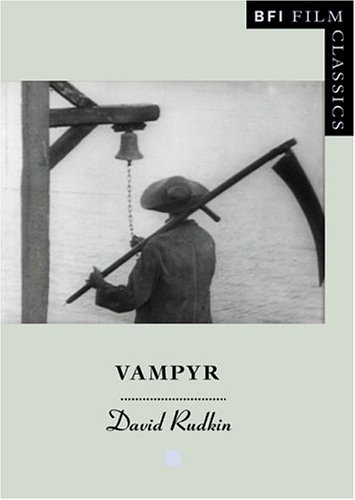
Vampyr, Der Traum des Allan Gray (1932) is one of the founding and defining works of psychological horror cinema, adapted from Gothic stories by Sheridan Le Fanu, a disturbing narrative of vampirism, obsession and posession of the soul. But it is also a film directed by Carl Theodor Dreyer, the revered and legendary Danish director of La Passion de Jeanne d’Arc (1927). Shot in France with private money and a largely nonprofessional cast and primitive sound equipment, Vampyr is to some extent a ruin. There is no definitive print and English versions are marred by poor image quality and subtitles. And yet it is unquestionably extraordinary, a vivid and haunting manifestation of Dreyer’s power to make visible on screen the inner human state, and to convey a dreamlike imagery of textures of nature amidst which transient, solitary human figures pass, some illuminated by an inner light, others threatened by a malign or demonic presence. In relation to Dreyer’s long but often frustrated career, Vampyr is often thought of as an uneven or disappointing film. But, according to David Rudkin, this is to misunderstand what it sets out to do, which is systematically to set the spectator adrift in a mysterious world. In a meticulous formal analysis of Vampyr, Rudkin expands on this contention, pinpointing the sources of the film’s uniquely disquieting effect. And yet, however strange it is, Vampyr remains a profound and troubling artwork concerned at the last to communicate human meanings—and none more so than the essence of death—in remarkable filmic imagery.
David Rudkin is a dramatist and screenwriter of forty years’standing. His theatre work is mainly associated with the Royal Shakespeare Company. Having collaborated with Tony Richardson, François Truffaut and Fred Zinnemann, his recent screenplays include Testimony (1987), for which he was awarded the New York Film Festival Gold Medal for Screenplay.