Monsieur Chat

m_chat.jpg

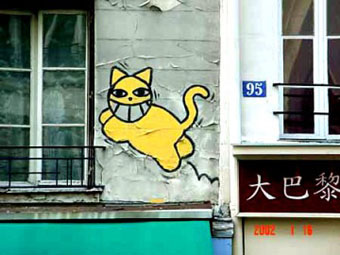
Who or what is the mysterious, grinning yellow cat? Wikipedia explains:

M. Chat (also known as Monsieur Chat and Mr Chat) is the name of a graffiti cat that appeared in Paris and other European cities in the months and years following the 9/11 terrorist attacks. The graffiti appeared most frequently on chimneys, but has been sighted in other places such as train platforms as well. It has also made appearances at political rallies. The originator of the street art remains anonymous.

The yellow cartoon cat is characterized by its large Cheshire Cat grin. The cat is most often portrayed in a running pose, but has also been variously depicted waving signal flags, bouncing on a ball, sporting angel wings, and waving in greeting at the entrance to a train station. It is sometimes accompanied by the tagline M. CHAT in small letters.

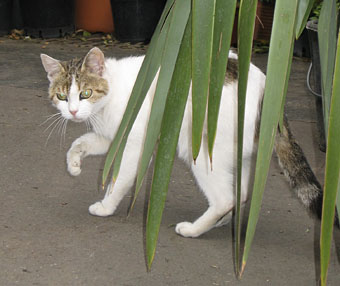
A shame I didn’t discover this phenomenon before I went to Paris last year, the city is cluttered with reproductions of Théophile Steinlen’s Chat Noir poster so it would have been fun to look for a more subversive animal. I found the wary creature below near the gardening market on the Ile de la Cité.
cat.jpg

French filmmaker Chris Marker is famously a feline aficionado so it’s no surprise that he’s made a documentary entitled The Case of the Grinning Cat (Chats perchés) examining the appearance of M Chat through the twin lenses of his video camera and his political concerns. A French site, Monsieur Chat (et autres…), similarly documents occurrences of the mysterious animal and this is their page about Marker’s film. Finally, there’s a Flickr pool although with fewer photographs than one might hope.

Via City of Sound.

Update: Monsieur Chat’s creator revealed (in French).

Previously on { feuilleton }
Sans Soleil

Angels 6: Paradise stands in the shadow of swords

stuck_angel.jpg

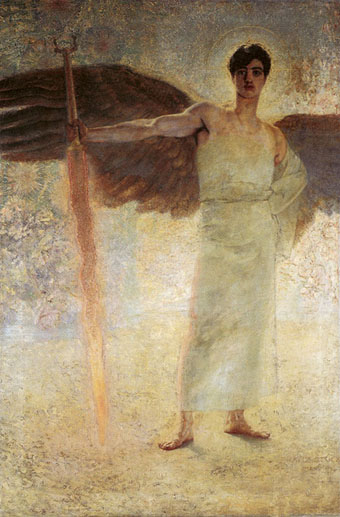
The Guardian of Paradise by Franz Stuck (1889).

We’ll let Coil have the final word on the angel theme, the post title being taken from their Cathedral In Flames. Those words recognise—as does the painting above—that the Christian concept of Heaven is of a gated community guarded by warriors to keep the undesirable at bay.

Symbolist painter Franz Stuck was (as far as we know) robustly heterosexual but his angel isn’t far removed from the work of contemporary photographers like Anthony Gayton who specialise in teasing out the erotic undercurrents in this kind of imagery. Which brings us full circle, seeing as we started with Caravaggio and his distinct brand of religious subversion. The irony is that some of the more vocal elements of Christianity can’t help subverting themselves or their own messages, as John Patterson notes in his Guardian piece today, alluding not only to the Ted Haggard debacle but also to Haggard’s favourite artist, Thomas Blackshear, both of whom were discussed here in November. Patterson writes that the recent brand of bigoted fervour that’s swept America seems to have abated, or at least retreated, after threatening to become a mainstream force. Europe often seems a haven of healthy heathen sanity by comparison, a part of the undesirable world being kept outside the American Paradise. St. Peter now demands retinal scans, fingerprints and a biometric passport. Continual rumbles from Pope Maledict and his closeted cardinals are an increasing irrelevance, the background static of a dying regime. Paradise may be guarded by attractive angels but we can only look and never touch. As Patterson says, the devil has all the best tunes. And the best books and movies and games. And sex and fun. I know which side of the fence I’d rather be on.

Elsewhere on { feuilleton }
The gay artists archive
The men with swords archive

Previously on { feuilleton }
Gay for God

Angels 3: A diversion

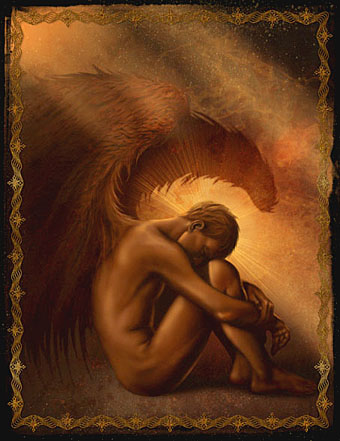
On Monday Eroom Nala mentioned my Fallen Angel picture in one of the comments for the first angel posting. Here’s the picture in question (from 2004).

fallen_angel.jpg

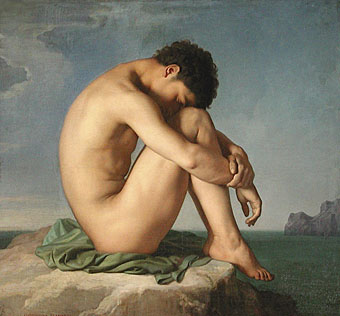
As I mentioned earlier, this was based on Jeune homme assis au bord de la mer (Young Man Sitting by the Seashore, 1836), the most well-known painting by Jean Hippolyte Flandrin (1809–1864). In a posting back in February I wrote about how this painting has become something of a gay icon over 170 years, with increasing numbers of artists and photographers working their own variations on the pose. As far as I was aware, I was the only person to have tried adding wings to the figure.

flandrin.jpg

Now today I run across a great gallery of photographs by Jose Manchado who has his rather gorgeous model, Reuben, adopt the same pose then gives him a set of abstract wings.

manchado.jpg

Manchado’s other photographs are well worth a look. He also adds more realistic wings to a female model but since we’re concerning ourselves with male angels this week I’ll leave you to look for her.

Elsewhere on { feuilleton }
The gay artists archive
The recurrent pose archive