Os Mutantes

os_mutantes.jpg

Os Mutantes: Back from Outer Space

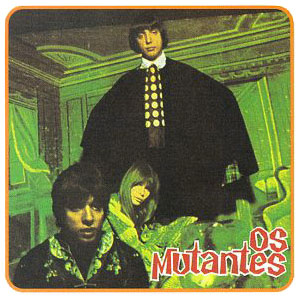
Though rarely heard outside their Brazilian homeland (especially during their brief career), Os Mutantes were one of the most dynamic, talented, radical bands of the psychedelic era – quite an accomplishment during a period when most every rock band spent quality time exploring the outer limits of pop music. A trio of brash musical experimentalists, the group fiddled with distortion, feedback, musique concrète, and studio tricks of all kinds to create a lighthearted, playful version of extreme Brazilian pop.

The band was formed by the two Baptista brothers, Arnaldo (bass, keyboards) and Sérgio (guitar). In 1964, the pair (sons of a celebrated São Paulo concert pianist) formed a teenage band named the Wooden Faces. After they met Rita Lee, the three played together in the Six Sided Rockers before graduation broke up the band. Yet another name change (to O Conjunto) preceded the formation of Os Mutantes in 1965, the name coming from the science fiction novel O Planeta Dos Mutantes. With a third Baptista brother (Cláudio) helping out on electronics, the group played each week on a Brazilian TV show (O Pequeno Mundo de Ronnie Von) and became involved with the burgeoning tropicalia movement. Mutantes backed tropicalista hero Gilberto Gil at the third annual Festival of Brazilian Music in 1967, then appeared on the watershed 1968 LP Tropicalia: Ou Panis et Circenses, a compilation of songs from the movement’s major figures: Gil, Caetano Veloso, Gal Costa, Tom Zé, and Nara Leão.

By the end of 1968, Os Mutantes delivered their self-titled debut, a raucous, entertaining mess of a record featuring long passages of environmental sounds, tape music, and tortured guitar lines no self-respecting engineer would’ve allowed in the mix (especially at such a high volume). After time spent backing Veloso and recording a second LP of similarly crazed psychedelic pop, the band ventured to France and Europe for a few music conference shows. Returning to Brazil, they set up their own multimedia extravaganza – complete with film, actors, dancing, and audience participation. Despite distractions of all kinds, the group also managed to record LPs in 1970 (Divina Comedia Ou Ando Meio Desligado) and 1971 (Jardim Eletrico), both of which charted the band’s shifting interests from psychedelic to blues and hard rock.

After 1972’s E Seus Cometas No Pais Do Baurets, Rita Lee departed or was fired from the band (accounts vary), and resumed a solo career that ran concurrently with Os Mutantes (her debut, 1970’s Build Up, had been co-produced by the Baptistas). Later Mutantes LPs displayed influences from prog rock, and after Arnaldo Baptista left the fold as well, the band’s LPs included a succession of bandmembers – later-to-be-legendary producer Liminha, keyboard player Túlio, and drummer Rui Motta. Except for a 1976 live record, 1974’s Tudo Foi Feito Pelo Sol was the band’s final LP. Sérgio later moved to America, where he played with Phil Manzanera, among others. After recording a 1974 solo album, Arnaldo played with a new band (Space Patrol) during the late ’70s and spent time in a psychiatric hospital before emerging for his second solo work, 1982’s Singin’ Alone. Meanwhile, though Rita Lee’s solo career began sputtering near the end of the ’80s, the band turned down a request for a 1993 reunion show by Nirvana’s Kurt Cobain. Six years later, the Omplatten label reissued the first three Mutantes records, and David Byrne assembled the Everything Is Possible compilation through Luaka Bop.

John Bush

Bruce Sterling: green design and “spimes”

Cyberpunk pioneer has designs on a better world

The author of seminal science-fiction works is taking a very pragmatic approach to the world’s environmental challenges

Interview by Anthony Alexander

Thursday June 1, 2006, The Guardian

Technology Guardian: How did you get into environmentalism and climate change?

Bruce Sterling: Science-fiction writers are not effective activists. But if I’m aware of some trend as a futurist and a trend-spotter, and if it actually shows up on my doorstep as an immediate crisis, then I will try to do something pragmatic. Science-fiction writers are best as fantasists. But if there is mayhem on your doorstep, it’s morally obligatory to take some action.

TG: So, what did you decide to do?

BS: To go public with my unease about climate change, to attack it as a design problem, from an industrial and engineering standpoint. I announced I was starting an internet mailing list, because the internet is the only global tech phenomenon of the global scope of climate change. My key insight there was that one huge phenomenon could be harnessed to attack the other.

I still run my list, but I soon got sucked into the world of design. I recently wrote a little book for MIT Press, which is an academic precis on the problem, a little manifesto. One thing led to another. Now there’s a raft of top-end, designery green retail outfits – treehugger.com, worldchanging.com – there are meetings of designer groups, and so on. That’s what I was hoping to provoke. I wasn’t the only one doing this, but I was one of the first to say: “Yeah, this can be done.” We could have a new kind of designer green, cyber-green, or as my colleague Alex Steffen puts it, “bright green”.

TG: You called your email list Viridian, a very bright cyber-green. It’s also a website, www.viridiandesign.org.

BS: It’s something between a diary, a squabble, an archive and a manifesto. I’m one guy. This is my hobby. But a likely, plausible step is a designer-green non-governmental organisation, with a board of directors and revenue, a magazine maybe. Big players are entering the green design space. Fighting the greenhouse effect is going to be a universal effort. Everyone will have to do it pretty much all the time.

TG: In your book Shaping Things, you describe climate change as the result of technology pioneers like Edison and Ford. Yet you say the only solution is to press forward with technology and shift to a new type of society.

BS: Not many science-fiction writers write industrial design manifestoes, but I was commissioned by Peter Lunenfeld of Arts Centre College of Design in California, where I was visionary in residence. Why do you want a sci-fi writer in a design school? You want someone who’ll think outside the box. The book talks about a new tech phenomenon with six or seven terms attached: the Internet of Things, Ubiquitous Computation, Everyware, Ambient Findability, Spimes (my term).

My own theory, which has gone into Shaping Things, is the key element is the identity for objects. It’s putting tags on things that allow them to interact with digital networks. That is the key concept around which other things accrue. My goal in this is sustainability. I want us to invent a better way to put our toys away. We are emitting too much junk. Google is good at sorting garbage. We could do something similar if we tagged our garbage, basically, everything we make.

Ideally, we need to tag an object before it exists. We need to tag the blueprints and then the manufactured object. Then, when it’s junk, we need to read it, know where it goes, have it ripped apart and recycled.

TG: Where does the concept of Spimes come from?

BS: Spimes was one of those spontaneous neologisms I came up with at a conference, a contraction of “space” and “time.” The idea is you no longer look at an object as an artefact, but as a process. A modern bottle of wine in one sense does exactly the same as the clay jug and stopper that the ancient Greeks used. On the other hand, it is now mass produced industrial glass, with a machine-applied label containing a barcode and a host of other information, even an associated web page. These invite you to do more than just drink the wine. These innovations link this product into a wider relationship.

Yet the moment the bottle is empty, we make a subtle semantic reclassification and designate it “trash”. The logistics of manufacture and distribution will already have tracked the bottle from factory, to warehouse, to store. But the relationship is not a closed loop. The moment you buy the wine, it’s your responsibility. The onus is on you to recycle it, or it’ll spend eternity in landfill. We really should be thinking about the trajectory all this stuff follows. We are in trouble as a culture because we don’t have a strong idea of where we are in time, and what we might need to do to deserve a future.

Amazon.com, for instance, allows you to study lots of information about physical products (books) without needing to consider the physical artefact itself. Or bookcrossing.com, a site where you can track physical books from reader to reader. Wheresgeorge.com does the same with dollar bills. Spimes are both the physical object and the metadata related to that object. Then, as with Amazon’s reviews, we can start adding correspondence on the nature of objects, creating a forum to discuss all our stuff and what to do with it.

TG: So how do RFID (radio frequency identification) chips relate to this?

BS: To study spimes we need to be able to track them. RFID chips are the next evolutionary step from bar codes. They allow objects to have an identity that can be easily read. They were invented by the Pentagon’s shipping, tracking and logistics agency, and Wal-Mart, the world’s largest retailer, inspired by some work at MIT. Unlike the barcode, which needs to be scanned up-close, you can just ping a whole warehouse, or delivery truck or cargo container, and an RFID scanner will simultaneously detect and log everything in there. You also see them in swipe cards. These tags make it extremely easy to assign identities to objects and connect them to databases.

TG: Opponents of RFID see it as malign and unwanted technology.

BS: The opposition should thoroughly understand the scope of RFID technology, otherwise they’ll be baling seawater with a fork. RFID is for grocery clerks. It’s not as mysterious or arcane a technology as space shuttles, nuclear triggers or Echelon.

Bruce Sterling’s book Shaping Things is published by MIT Press.

Blade Runner DVD

blade_runner.jpg

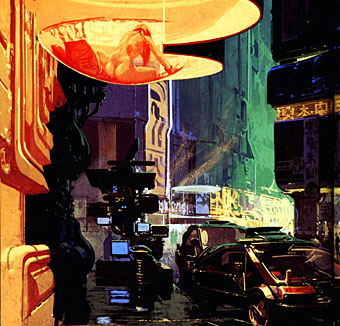
Blade Runner concept painting by the great Syd Mead.

Several reliable news sources are reporting that Blade Runner is to finally receive a decent DVD release.

In September of 2006, Warner Home Video will release a restored and remastered version of the Blade Runner 1992 Director’s Cut for a special four month limited release, in anticipation of a series of exciting and unprecedented releases of the film in theaters and on DVD.

Following a four month run of the remastered Blade Runner DVD, this disc will be placed on moratorium, by WHV. In 2007, Warner will follow with a limited theatrical run of Blade Runner: The Final Cut, which is being touted as Ridley Scott’s definitive version. Subsequently, there will be a multi-disc Special Edition DVD release which will contain three alternate versions of the film: the original U.S. theatrical cut, the expanded international theatrical cut and the 1992 director’s cut. “Ample, groundbreaking bonus features will also be included,” according to the WHV press release.

Blade Runner has been on DVD already in a very shoddy edition that’s now happily deleted, a rush release from the early days of DVD. Most news reports don’t seem to mention that the re-issue of the film was held up by various legal wrangles; the Blade Runner fan site, BRmovie.com, details the whole sorry tale. Here’s hoping Ridley’s masterpiece will be given the same treatment as the excellent (if unfortunately named) Alien Quadrilogy which had great transfers of the films and an insane amount of extras.

Jay on the radio

Later today, boys and girls…

Jay Babcock’s interview with Godsmack (a big band in America, apparently…) about the use of their music in ads for the US military caused quite a stir earlier this month after the band had a hissy fit and put the phone down on him. I posted the interview here and the Arthur magazine page below has over 200 comments discussing the whole business. So far the debate has generated more heat than light so the radio discussion is most welcome.

ARTHUR ON “AIRAMERICARADIO” NETWORK, WEDNESDAY MAY 31.
Thanks to the efforts of PressHere’s Chloe Walsh, Arthur editor Jay Babcock will be guest on national progressive radio network AirAmericaRadio’s ‘The Marc Maron Show’ on Wednesday, May 31. He’ll be discussing the ARTHUR VS GODSMACK kerfuffle and also Arthur’s forthcoming “So Much Fire to Roast Human Flesh” CD (curated by JOSEPHINE FOSTER) which will **benefit ANTI-MILITARY RECRUITING campaigns**.

It’s going to be AWESOME.

• Info on the show:
www.airamericaradio.com/maron/

• AirAmerica radio network stations:
www.airamericaradio.com/stations

• Listeners on the internet can stream live at
www.airamericaradio.com

• Alternatively you can stream starting at 11p.m. PST from the Los Angeles Air America Radio affiliate KTLK 1150-AM’s website at www.ktlkam1150.com/pages/streaming.html

• Transcript of the original Arthur v Godsmack interview (May 1, 2006), with Introduction, Afterword and Footnotes: www.arthurmag.com/magpie/?p=1244

• Howie Klein commentary at The Huffington Post (May 8, 2006):
www.huffingtonpost.com/howie-klein/not-all-rock-stars-are-li_b_20648.html

• New York Daily News on Arthur vs Godsmack (May 10, 2006):
www.nydailynews.com/news/gossip/story/416382p-351810c.html

• CNN Headline News’s ‘Showbiz Tonight’ interviews Godsmack on controversy – transcript (May 11, 2006):
transcripts.cnn.com/TRANSCRIPTS/0605/11/sbt.01.html

• Streaming audio of Arthur vs Godsmack interview (May 1, 2006) (courtesy Apollo Audio and Bobby Tamkin):
www.apolloaudio.com/lt.asp?name=AA32

• MP3 of the Arthur vs Godsmack interview (May 1, 2006) (courtesy Crooksandliars.com and Bobby Tamkin):
movies.crooksandliars.com/arthurvsgodsmack.mp3