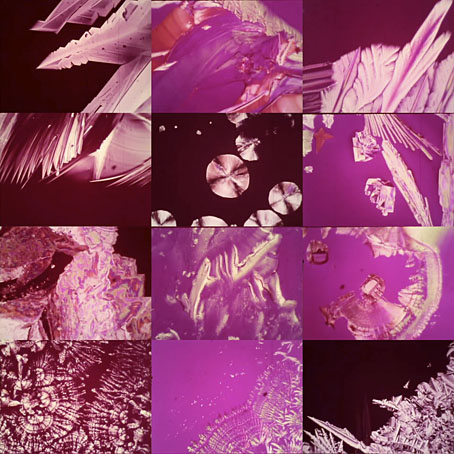
Given the year it was made, Crystals (1968) has unavoidable, if inadvertent, psychedelic connotations, especially when you see these iridescent forms blooming against vivid backdrops. The same can’t be said for the music that accompanies Herbert Loebel’s photography, however, so once again I’d recommend watching this with a soundtrack of your own choosing.
Category: {abstract cinema}
Abstract cinema
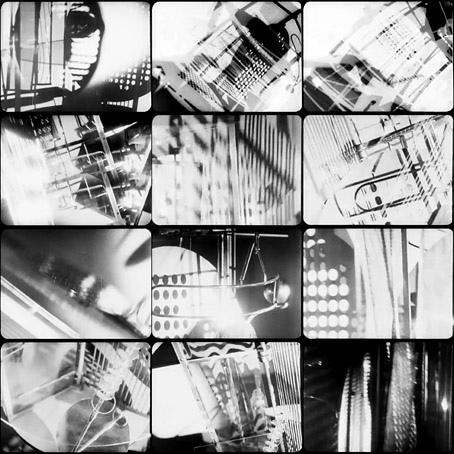
Lichtspiel Schwarz-Weiss-Grau, a film by László Moholy-Nagy
A beguiling short from 1930 made by the Hungarian artist to demonstrate the patterns of light and shade created by his Light-Space Modulator (aka Light Prop for an Electric Stage, 1922–1930), an early kinetic sculpture. The film could have worked well enough as a series of documentary shots but Moholy-Nagy compounds the effects with superimposition, lens fragmentation and even a brief negative sequence. Watch it here.
Previously on { feuilleton }
• Ballet Mécanique
Fu Liu, a film by Xiang Pu Zhu
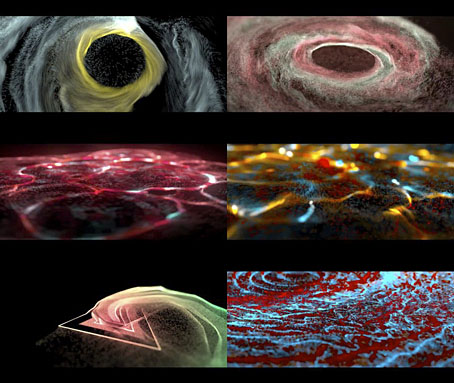
According to the notes for Xiang Pu Zhu’s short demo piece, all the shots here are computer generated. Some are more obvious than others but the combinations of liquid and particles are very impressive. The music is by Esther Garcia.
White Hole, a film by Toshio Matsumoto
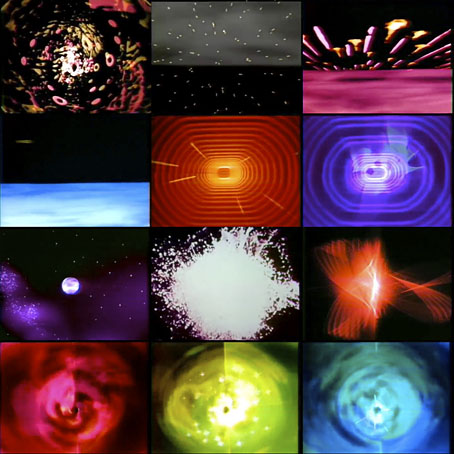
Another short film by Matsumoto. This one was made in 1979, and seems to employ video effects, but the results are cosmic and psychedelic enough to have appeared ten years earlier. The electronic score is by Joji Yuasa. An entrancing 6-minute trip. Watch it here.
Previously on { feuilleton }
• Atman, a film by Toshio Matsumoto
• Metastasis, a film by Toshio Matsumoto
Mothlight, a film by Stan Brakhage
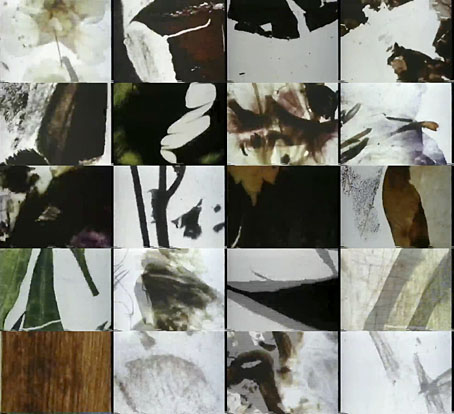
One of the common methods of making a no-budget abstract film was to scratch or paint directly onto the film itself, a technique popularised by Len Lye in the 1930s. Mothlight (1963) by Stan Brakhage works a variation on the process by gluing broken moth wings, leaves and other bits of natural detritus to a length of film. It only runs for three minutes but it’s a classic piece of experimental cinema. As usual with Brakhage, the titles are hand-drawn, and the film itself is silent.
Elsewhere on { feuilleton }
• The abstract cinema archive