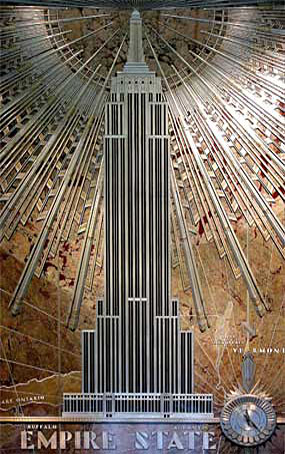
The Empire State Building, 75 years old today.
A journal by artist and designer John Coulthart.

Architecture
The Empire State Building, 75 years old today.
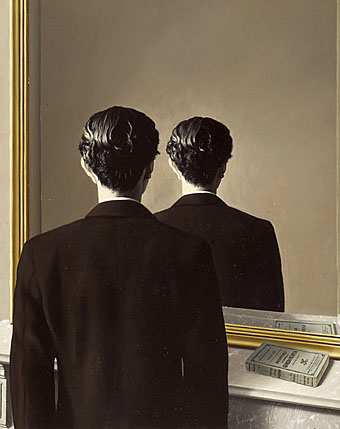
Edward James by René Magritte, La Reproduction Interdite (1937).
Art collector Edward James (1907–1984) was a characteristically English eccentric, a kind of 20th century equivalent of William Beckford or Horace Walpole, who was captivated by Surrealism in the 1930s and became a lifelong devotee of the movement. Much of his inherited wealth was spent supporting artists such as Salvador Dalí, René Magritte and Lenora Carrington and his homes at Monkton House and Walpole Street in London were transformed into showcases of Surrealist decor; Dalí’s famous sofa modelled on Mae West’s lips was designed with assistance from James.

HDR photos of Tokyo. This page explains HDR.
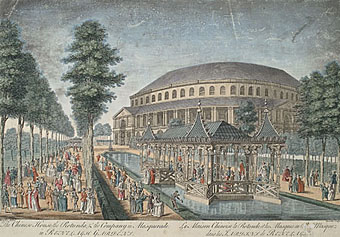
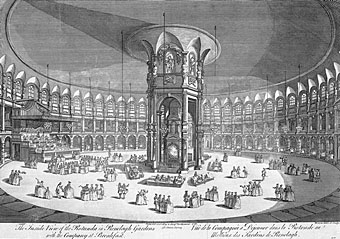
Exterior and interior views by Thomas Bowles, 1754.
This was one of the most popular places of entertainment in the 18th century. The Rotunda was vast and features included tiered boxes, a fireplace in the centre and an orchestra pit and the diameter was said to be greater than the Coliseum in Rome. Everyone in society from Princes downwards attended the lavish firework displays, the concerts and the infamous masked balls. Its popularity began to wane and the Gardens closed in 1803.
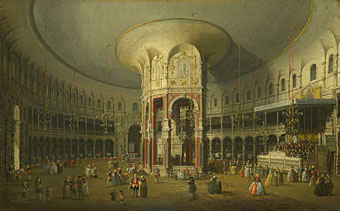
Interior view by Canaletto.
The inscription in Italian on the back of the original canvas states that the picture was painted in London in 1754 for the artist’s patron Thomas Hollis, and that the view was unique in the artist’s work. The Rotunda in Ranelagh Gardens, Chelsea, was erected as a public venue for various entertainments in 1741 and closed in 1803. Musical concerts were held and Mozart performed there in 1764.
Elsewhere on { feuilleton }
• The etching and engraving archive
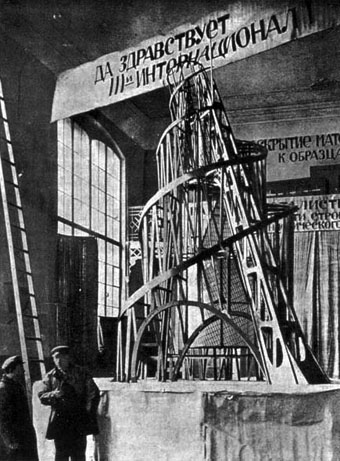
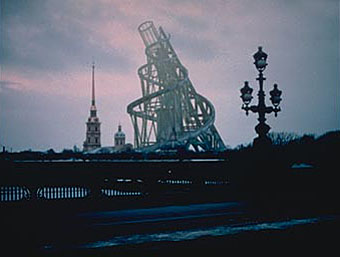
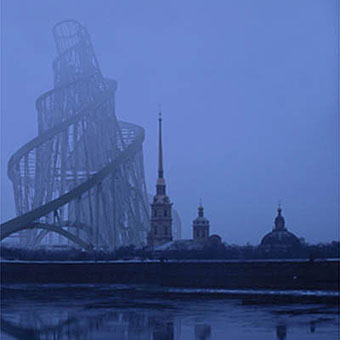
The Monument to the Third International would have loomed 400 metres over St Petersburg (100 metres taller than the Eiffel Tower) had it been built after the Revolution of 1917. The building was intended as a monument, exhibition space and location for the Comintern offices, and included several blocks within its structure, a cube, pyramid and cyclinder, that would revolve at different speeds. Unfortunately for architect Vladimir Tatlin, the Civil War put paid to his plans, although it was estimated that even if the country had been peacable enough to allow its construction, the vast frame would have used up all the steel in the Soviet Union.
All unbuilt structures tend to evoke a “what if?” response and Tatlin’s Tower has been given virtual life through this impulse in Takehiko Nagakura’s 1999 film of the same name. Nagakura uses CGI to show how the building would look against the skyline of the real St Petersburg.