Louis Bonnier’s exposition dreams

bonnier1.jpg

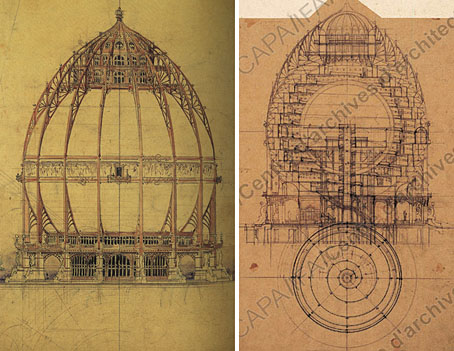
Globe terrestre.

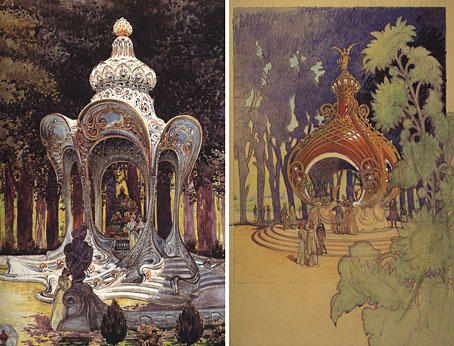
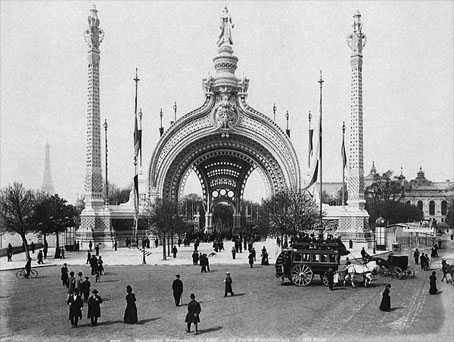
More exposition mania. The Paris Exposition Universelle of 1900 would have been more grand/fabulous/excessive (delete as appropriate) if architect Louis Bonnier had been given free reign. The building above was intended to stand before the Palais du Trocadéro and house a huge globe which visitors could peruse from surrounding galleries. Bonnier also designed a series of kiosks (below) for different exhibitors which look more like over-sized Art Nouveau ornaments than pieces of architecture.

Three of these pictures are scanned from a book; the only site I found with examples of Bonnier’s work was this one which unfortunately spoils the pictures with enormous watermarks.

bonnier2.jpg

Exposition kiosks.

Previously on { feuilleton }
Exposition Universelle, 1900
The Maison Lavirotte
The Palais du Trocadéro

Exposition Universelle, 1900

exposition1.jpg

La porte monumentale.

Was the Paris Exposition of 1900 the most gloriously excessive of them all? Judging by these photos it certainly looks it. I should have linked to these earlier when I had a post about the Palais du Trocadéro which was one of the buildings raised for the occasion. The Eiffel Tower was built for the 1889 exposition (and was famously intended to be a temporary structure) but became the centrepiece of the 1900 fair. Wikipedia has a large plan of the entire layout and two of the halls, the Grand and Petit Palais, are still in existence and used as exhibition spaces.

Continue reading “Exposition Universelle, 1900”

Set in Stone

allchurch.jpg

Urban Chiaroscuro 6: Paris (after Piranesi) (2007) by Emily Allchurch.

Pitzhanger Manor-House in Ealing, London, hosts an exhibition with architecture as its theme, a suitable subject given that the house was designed by notable 18th century architect (and friend of Piranesi) Sir John Soane. Artist Emily Allchurch has some meticulous and clever photo-collage reworkings of Piranesi on display while painter Stefan Hoenerloh—whose work I hadn’t seen before—is worthy of a dedicated post here seeing as he produces exactly the kind of imaginary architectural renderings I love. Some of his paintings could be colour views of similar scenes by Gérard Trignac.

hoenerloh.jpg

Via Subalterna (1990) by Stefan Hoenerloh.

Set in Stone runs from 28 March–26 April 2008.

Artists: Emily Allchurch, Stephen Carter, Michael Durning, Stefan Hoenerloh and Ben Johnson.

PM Gallery present the work of five artists who share a fascination in the power and importance of architecture, as an inspiration for works in paint and photography.

Emily Allchurch makes collages from many photographs to create a seamless new ‘view’, creating imaginary buildings or recreating buildings that no longer exist. A series of works, inspired by the 16th Century (sic) artist Giovanni Battista Piranesi’s ‘Carceri d’Invenzione’ (Imaginary Prisons), seamlessly constructs Piranesi’s original work but shows buildings constructed in a mass of architectural styles, complete with warning signs, CCTV cameras, razor wire and security mirrors to give a sense of foreboding and claustrophobia. In ‘Crystal Palace, (recomposed)’, she took what remains of the platform as a basis to recreate the palace, using architectural details of the period, such as at the Palm House at Kew Gardens and Paddington Station.

The detail of London’s Westway has been examined by Stephen Carter, with a series of paintings taken from photographs shot beneath the huge concrete flyover. Carter sees the Westway as representing both an escape for city dwellers to the beauty of the countryside and for country dwellers to get to the exciting heart of the city. But this optimism is tempered by the fact that the perspective is often viewed from below the Westway in a forgotten, uncelebrated and polluted part of the city.

Michael Durning’s beautiful paintings of neglected and broken monuments and buildings, question attitudes to Scottish heritage and culture. Often buildings are shown in relation to Scotland’s grand landscapes and unforgiving weather, reducing their prowess in the face of the natural environment.

German painter Stefan Hoenerloh creates monumental buildings with accurate, detailed architectural features, in oil and acrylic. The works appear photographic, but in fact are all invented by Hoenerloh. The buildings loom, often so large that the viewer is only able to see part of them within the frame of the picture. There is little sign of life in these structures, which appear old and weather-beaten, but solid in the face of everything they have withstood over the years since they were built.

Ben Johnson paints calm, often majestic interiors and large city panoramas. Although painted in meticulous detail, Johnson ‘ investigates’ the built space, to create far more than simple photo-realism, allowing the viewer to gain an intense experience of the presented space. Here we show work dating from 1973 to 2007.

Elsewhere on { feuilleton }
The etching and engraving archive
The fantastic art archive

Previously on { feuilleton }
The art of Gérard Trignac
Aldous Huxley on Piranesi’s Prisons

The Maison Lavirotte

lavirotte11.jpg

More Art Nouveau and more Paris…. I can’t believe I missed this place when I was in Paris for a week, staying just a few streets away. The building is at 29 Avenue Rapp in the 7th arrondissement and I crossed that street several times when walking to the Champs de Mars and the Eiffel Tower.

lavirotte2.jpg

The architect was Jules Lavirotte (1864–1929) and the building was named after him following its construction in 1901. His other works aren’t as excessively florid as this, nor do they display the Nouveau elegance of contemporaries such as Hector Guimard, so this façade may owe more to the capitulations of fashion than innate style. The attractively unclad figures on the pediment cock their hips at passers-by in a provocative manner that would never be allowed in British architecture of the period, and the door has some great details with stylised peacocks between the windows and a huge brass lizard for the handle.

Continue reading “The Maison Lavirotte”

The Palais du Trocadéro

trocadero.jpg

More ephemeral architecture and also another example of old exposition architecture. The Palais du Trocadéro was designed by Gabriel Davioud for the 1878 World’s Fair and until its demolition in the 1930s faced the Eiffel Tower across the Seine after that edifice had been constructed as the entrance arch for another fair, the Exposition Universelle of 1889. Davioud designed other less extravagant works for Paris, including the Fontaine St Michel which I photographed during one of my visits there in 2006.

The Trocadéro is something of a heavy-handed confection, ostensibly “Moorish” in that Orientalist fashion favoured by 19th century architects. The numerous photographs of the place give it the same quality of ghostly grandeur that so many these long-demolished buildings possess; we’re able to look at a very real place which has now vanished utterly. The bridge in the picture below still stands, however, and the balcony of the Trocadéro’s replacement, the Palais de Chaillot, gives great views of the Eiffel Tower and the river.

trocadero1.jpg

Previously on { feuilleton }
The Evanescent City
Ephemeral architecture
Winsor McCay’s Hippodrome souvenirs