Koho Shoda’s nocturnes

shoda01.jpg

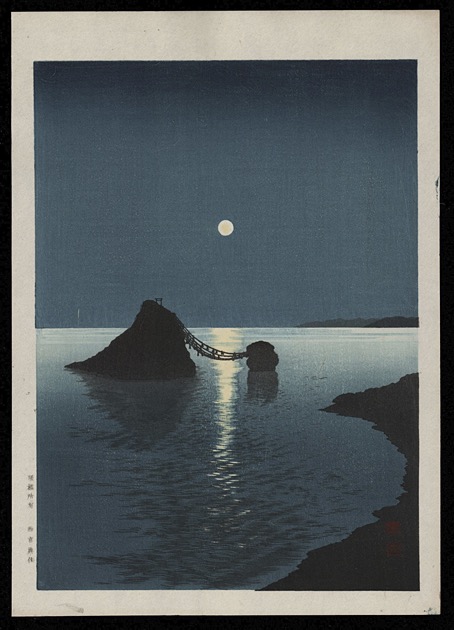
Futamigaura.

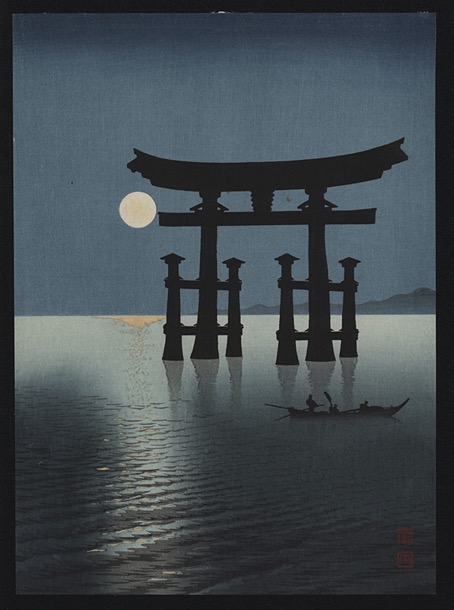
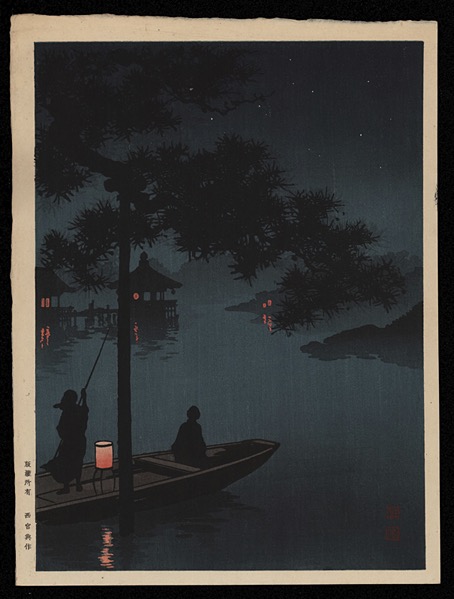
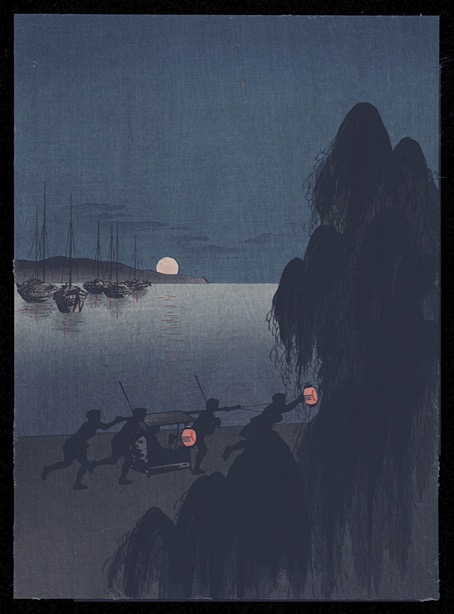
The biographical dates (1871–1946) are apparently uncertain for this Japanese artist about whom little documentation exists. What we do have is the prints he created, a couple of which have appeared here before. Nocturnes were Shoda’s speciality, together with other atmospheric scenes created with carefully graded colouring. As always with prints such as these, I’m in awe of the artist’s ability to create a sense of verisimilitude in the difficult medium of woodblock printing.

shoda09.jpg

Shrine Gate of Miyajima.

shoda05.jpg

Lake Biwa.

shoda08.jpg

Shinagawa Shore.

shoda10.jpg

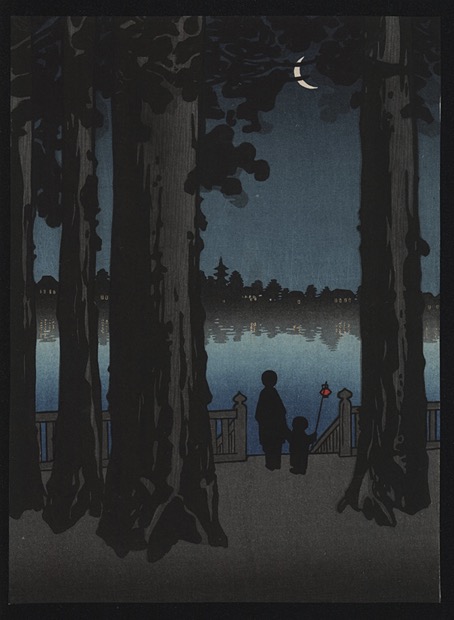
Uyeno Park.

Continue reading “Koho Shoda’s nocturnes”

Sixteen views of Meoto Iwa

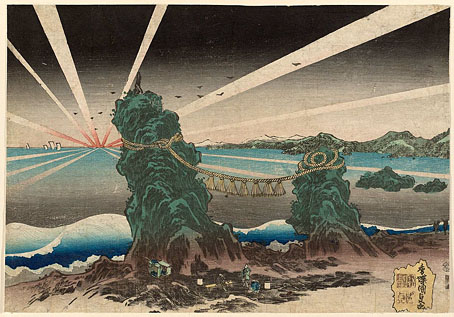
futamigaura08.jpg

Dawn at Futamigaura (c. 1832) by Kunisada.

Meoto Iwa, or the Married Couple Rocks, are two rocky stacks in the sea off Futami, Mie, Japan. They are joined by a shimenawa (a heavy rope of rice straw) and are considered sacred by worshippers at the neighboring Futami Okitama Shrine (Futami Okitama Jinja). According to Shinto, the rocks represent the union of the creator of kami, Izanagi and Izanami. The rocks, therefore, celebrate the union in marriage of man and woman. The rope, which weighs 40 kilograms, must be replaced several times a year in a special ceremony. The larger rock, said to be male, has a small torii at its peak.

At dawn during the summer, the sun appears to rise between the two rocks. Mount Fuji is visible in the distance. At low tide, the rocks are not separated by water. (more)
futamigaura14.jpg

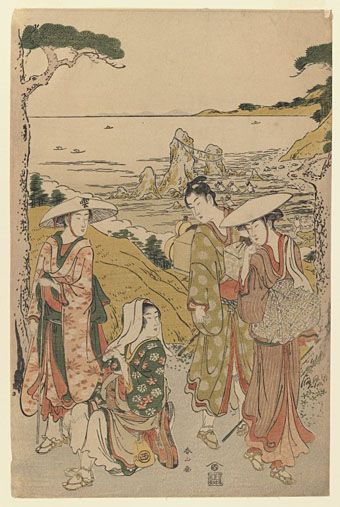
A Company of Pilgrims from Yedo Outside a Tea House on the Hills Behind the Beach of Futami Admiring the View (c. 1795) by Katsukawa Shunzan.
futamigaura06.jpg

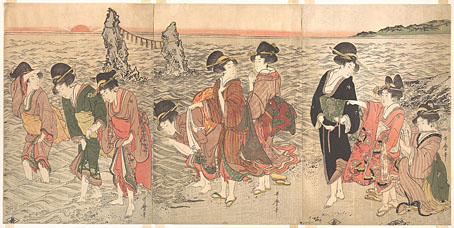
Women Worshiping the Rising Sun between the Twin Rocks at Ise (c. 1803–04) by Kitagawa Utamaro.
futamigaura03.jpg

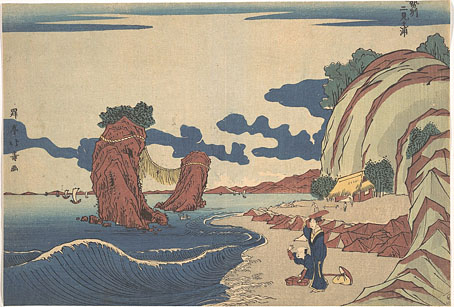
Futamigaura (c. 1825) by Shotei Hokuji.
futamigaura12.jpg

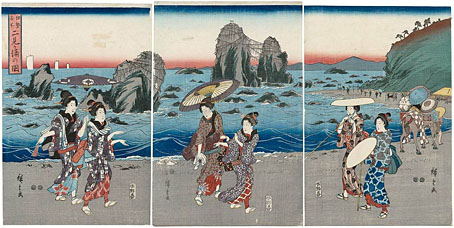
View of Futamigaura from Famous Places in Ise (1847–52) by Hiroshige.

Continue reading “Sixteen views of Meoto Iwa”

Japanese moons

lunar17.jpg

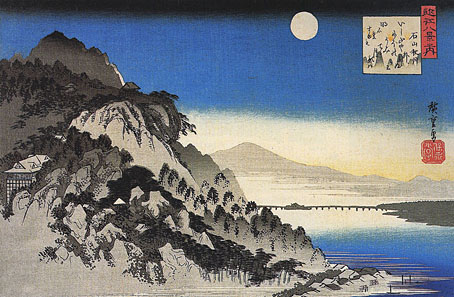
Autumn Moon At Ishiyama Temple (c. 1834) by Hiroshige.

The moon is a continual feature in Japanese landscape prints, and the following selection is only a small sample of the many beautiful examples that may be found on this print site. See also this site, and Yoshitoshi’s stunning series, One Hundred Aspects of the Moon.

lunar25.jpg

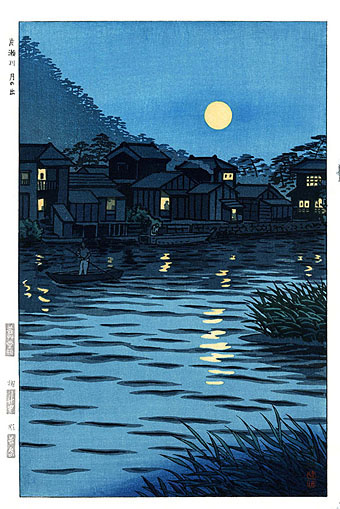
Rising Moon at Nagase (no date) Artist unknown.

lunar24.jpg

Rising Moon at Katase River (1907) by Shiron Kasamatsu.

Continue reading “Japanese moons”

Nocturnes

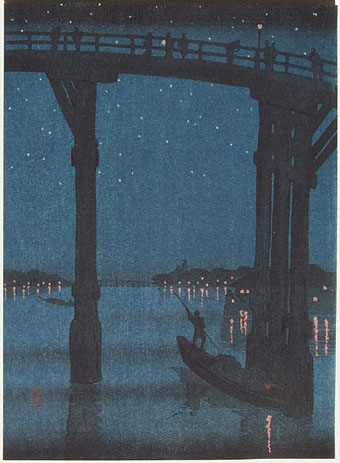
night1.jpg

KOBAYASHI, Eijiro–”A High Bridge by Night”

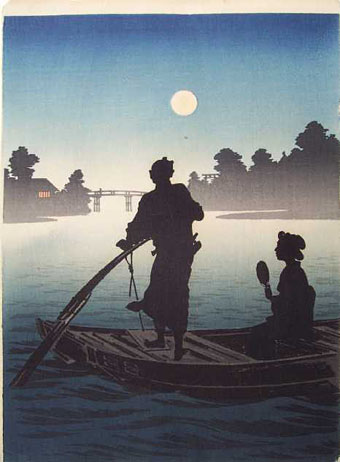
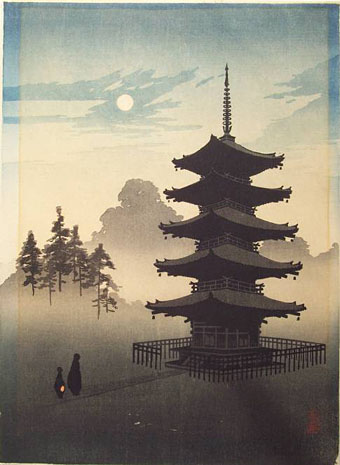
The Night Scenes is a series of 21 woodcut prints by Japanese artists published by Hasegawa/Nishinomiya in the early 1900s. Gorgeous work, and apparently popular enough for the prints to have been reissued many times since. These examples are from a print-selling site with several extensive galleries of 20th-century Japanese prints.

The High Bridge at Night struck me for being remarkably similar to Whistler’s famous painting of Old Battersea Bridge, Nocturne: Blue and Gold (1872–75). Whistler, of course, developed his mature style through looking at Japanese prints, and the Tate’s note for his painting says it may have been derived from a Hiroshige print. The Hiroshige looks nothing like the High Bridge at Night, however; was the latter based on an earlier print which Whistler had seen, or is the High Bridge (which post-dates Whistler’s painting) an example of the Japanese stealing back some of their influence from the West?

(Thanks to Wood s Lot for the prints tip.)

night2.jpg

ARAI, Yoshimune II–”A Ferry Boat”

night3.jpg

KOBAYASHI, Eijiro–”A Pagoda by Moonlight”

Continue reading “Nocturnes”