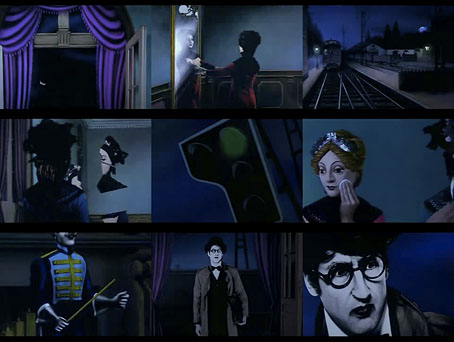
Papillons de Nuit, a film by Raoul Servais

papillons.jpg

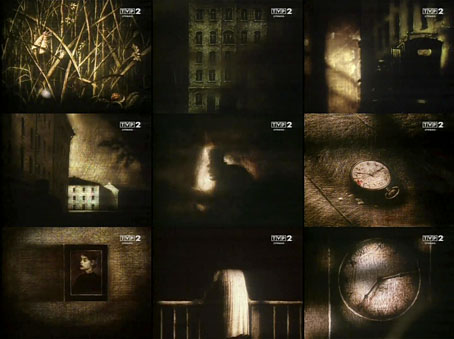
From Homosurrealism to Belgio-surrealism. Papillons de Nuit (1997) is a short homage to the Surrealist painter Paul Delvaux featuring a handful of familiar Delvaux motifs including nocturnal tramcars and large-eyed, bare-breasted women. Raoul Servais had already borrowed some of Delvaux’s imagery for his feature-length fantasy, Taxandria (1994), but that film doesn’t sustain itself over its running time despite the involvement of Alain Robbe-Grillet and François Schuiten. Servais’s blend of live action and animation seems to work better in concentrated doses.

Previously on { feuilleton }
Sirene by Raoul Servais
Paul Delvaux: The Sleepwalker of Saint-Idesbald
Harpya by Raoul Servais
Taxandria, or Raoul Servais meets Paul Delvaux
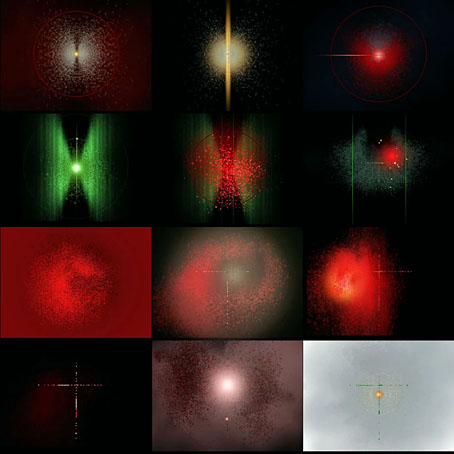
Continu-discontinu 2010, a film by Piotr Kamler

continu.jpg

A recent film by Piotr Kamler that’s not on the DVD collection from aaa, Continu-discontinu 2010 is a short animation that’s a lot more abstract than Kamler’s earlier works although you might detect the director’s hand in the motion of some of its wandering particles. In place of the electronic scores that soundtrack many of his films there’s a recording of a viol piece composed by Marin Marais.

Previously on { feuilleton }
L’Araignéléphant
Le labyrinthe and Coeur de secours
Chronopolis by Piotr Kamler

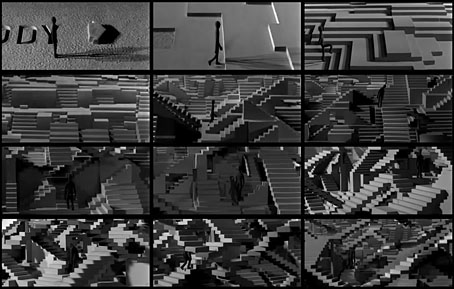
Stairs, a film by Stefan Schabenbeck

stairs.jpg

YouTube in recent years has become an increasingly worthwhile repository for short animations or experimental films, many of which you might otherwise never get to see. Stairs (1969) is another great piece of Polish animation, a brief scenario concerning a Plasticine figure who wanders into a terrain of random steps which soon turns mountainous. The obvious precursor is MC Escher’s stairways, but Escher’s worlds are always very formal despite their paradoxes. Schabenbeck’s film, like many Eastern European animations, can be read as allegory although this only becomes apparent at the very end. Watch it here.

Previously on { feuilleton }
Walls, a film by Piotr Dumala

Crime and Punishment, a film by Piotr Dumala

dumala2.jpg

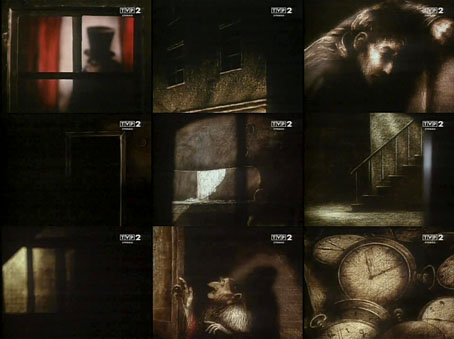
More from the Polish animator, and a stunning, wordless adaptation of Dostoevsky’s novel. Crime and Punishment dates from 2000, and utilises the same technique as Dumala’s earlier films—images scratched into a plaster ground—only this time there’s a muted colour palette and considerable depth achieved through cast shadows and blurred objects layered over the drawings. Yuri Norstein achieved a similar sense of depth in Hedgehog in the Fog (1975) and Tale of Tales (1979), and Dumala’s film also shares the latter’s umber tones and sombre lighting. The story is pared to its bones, as it would be with a running time of 30 minutes, but it’s still a marvellous adaptation. There’s even a nod to Walls when an omnipresent fly disappears for a moment into a hole in the wallpaper.

dumala3.jpg

Previously on { feuilleton }
Walls, a film by Piotr Dumala
Academy Leader Variations
Yuri Norstein animations
Screening Kafka

Walls, a film by Piotr Dumala

dumala.jpg

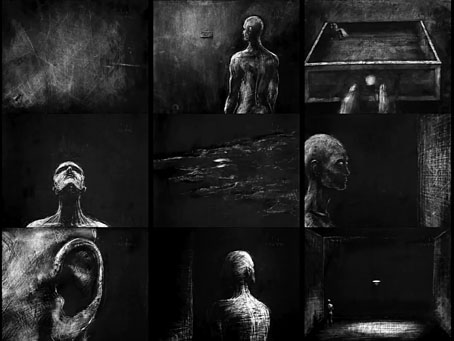
Polish animator Piotr Dumala was among the filmmakers contributing to Academy Leader Variations, the short anthology that was the subject of a recent post. He also received a mention in the Screening Kafka post for his memorable animated portrait of Franz Kafka. Walls (1988) is another short film made just after Academy Leader Variations, and like all of Dumala’s films the images are created by scratching lines into painted plaster. The cross-hatching that results from this means the animated images are much closer to drawings than the vaguely similar pinscreen animations of Alexandre Alexeieff and Claire Parker. Walls is moody, inexplicable, and may be watched here.

Previously on { feuilleton }
Academy Leader Variations
Screening Kafka