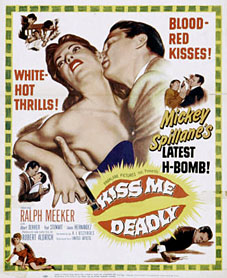
Kiss Me Deadly

“Va-va-voom!” Kiss Me Deadly (1955) and Orson Welles’s great Touch of Evil (1958) both came at the end of the film noir cycle in the late 1950s. Both films look into the dark heart of American life during that decade, with Aldrich tackling nuclear paranoia and Welles dealing with racism towards Latin-Americans and political and legal corruption. Both films have long been favourites of mine and both remain startlingly relevant now, as Alex Cox discusses below. Cox might have mentioned another film that borrows the motif of the baleful nuclear box, his own Repo Man (1984).
Nuclear-powered nastiness
It’s one of the darkest noirs ever made. But, says Alex Cox, the classic Kiss Me Deadly is a parable at heart
Alex Cox
Friday June 16, 2006
The Guardian
It begins with titles that famously run backwards. Deadly … Kiss Me … Aldrich … Robert … Directed by … Then, two scenes in, a women we have assumed to be the heroine is tortured to death. This is no art film, though; no knowing homage. Instead, it’s the roughest, least compromising film noir of them all - Kiss Me Deadly.
The hero (if we can call him that) is Mike Hammer, a tough, no-nonsense detective created by pulp fiction author Micky Spillane. Spillane’s Hammer was of a different breed from the detectives who had gone before. Dashiell Hammett’s Continental Op and Raymond Chandler’s Marlowe were tough and cynical, but also intelligent, decent and insightful. Spillane’s Hammer was an indecent thug. A product of Senator McCarthy and the blood-lust of the Korean war, he liked nothing better than pounding commie sympathisers’ heads against a wall until their eyeballs popped.
Robert Aldrich’s Hammer - played by the oddly named Ralph Meeker - is worse than Spillane’s. Aldrich’s protaganist is cynical and dumb; a thug without insight, a detective who fails to detect. In a way, he is a prototype for the automaton-hero played by Lee Marvin in 1967’s Point Blank, and done to a turn by Arnold Schwarzenegger in The Terminator.

Made in 1955 - the fine black and white photography is by Ernest Laszlo - Kiss Me Deadly is filled with the trappings of modernity. Hammer has a reel-to-reel telephone answering machine in his apartment. Despite this, and his predeliction for fast sports cars and faster women, he achieves next to nothing. He doesn’t solve the mystery. He doesn’t get his man.
Kiss Me Deadly inevitably suffered problems with the British censor. But it’s hard to see what Trevelyan or Harlech could do about it, other than ban it outright. The torture of Christina (Cloris Leachman) is played off screen. It seems almost tasteful in comparison to the woman-hating antics of V for Vendetta or Kill Bill. More disturbing is Hammer’s casual sadism - as when, looking for information, he destroys an opera-lover’s record collection, or traps an old man’s hand in a desk drawer.
Aldrich was a bold and radical director, masquerading as a maker of popular action films. Kiss Me Deadly, disguised as tough-guy detective picture, is actually an anti-nuclear parable with classical allusions - most obviously, to the story of Pandora and her box.
The script was by AI Bezzerides. That must have infuriated Spillane, since Bezzerides was a leftist, blacklisted screenwriter. Aldrich took a risk working with such a writer. Aldrich, director of The Big Knife - a rigorous dissection of a corrupt, crowd-pleasing Hollywood movie star whose criminal past makes him the studio’s patsy - clearly didn’t care. Like his protagonist, he steamrollered ahead, doing what he wanted. And what he wanted, at the height of the McCarthy frenzy, was to warn us that nuclear power was going to destroy us all.
Only one character knows what Kiss Me Deadly is about. GE (General Electric?) Soberin, a spooky gangster who has got his hands on stolen nuclear material, which he intends to sell to the highest bidder. All the other men in the film are ignorant dolts, obsessed with machines and toys, most of all Hammer. By contrast, the women, including Hammer’s assistant, Velda (Aldrich regular Maxine Cooper) seem to intuit what’s going on. Only the Pandora character, Lily (Gaby Rodgers), likes what she sees: access to great power and influence. In this sense, Lily is the manliest character in the film.
Velma, the ever helpful, ever sexy, ever available secretary (who lives in the office, like Tony Curtis in The Sweet Smell of Success) loves Mike and regrets his stupidity. Without knowing what it is, she calls the box “the great whatsit”.
Perhaps as a result, the mysterious box has been described as a classic “MacGuffin” - or an arbitrary plot device of no real significance (”The 39 steps are …” Bang! “Aaargh!”) - and as a surrealist device like the boxes in Luis Buñuel’s Un Chien Andalou and Belle de Jour, and the briefcase in Quentin Tarantino’s Pulp Fiction.
Yet, it is neither of these things. The lead box in Kiss Me Deadly is real, and specific: its contents are glowing, unstable radioactive isotopes, which - when the box is opened - set off an explosive chain reaction that can’t be contained. Instead, the characters are the MacGuffins.
In his excellent book Dreams and Dead Ends: The American Gangster Film, Jack Shadoian points out that in Kiss Me Deadly we know everyone’s full name (even the minor hoodlum played by Jack Elam has a name, Charlie Max). Yet Bezzerides’ excessive detail works in reverse (like the backwards title sequence) - rendering Mike’s familiar, tough-guy world both complex and meaningless. Only the box is real; only the box has meaning. Both Hammer and Soberin say their names don’t matter. Adversaries, they are identical meat puppets, driven by basic animal desires: to dominate, to take, to consume.
In the hands of another director, this might be considered accidental. But there are no accidents in Kiss Me Deadly, no irrelevant scenes. Aldrich returned to the nuclear issue for another film, late in his career: Twilight’s Last Gleaming in 1977.
This, too, was a thriller made of the horror-stuff of Hiroshima and Nagasaki, in which an American general, played by Burt Lancaster, tries to provoke a nuclear confrontation so as to teach the world - the hard way - of the dangers of atomic war. It’s not a successful film. Aldrich’s powers were fading, and the script is nowhere near as precise or intelligent, but clearly he cared enough about the nuclear threat to return to it a second time.
Made half a century ago, Kiss Me Deadly seems entirely contemporary. The other week, the cops knocked down doors and shot a man in east London, looking for WMD. Like Aldrich’s protagonist, they came up empty-handed, too. But still we’re warned the threat is real. The US government acts as if Mike Hammer were a nation-state, reserving the right of “extraordinary rendition” - torture, Aldrich might call it - to get to the bottom of a mystery they’ve designed.
But is the US really Hammer, the implacable, ignorant detective? Or is it Lily/Pandora, far too fascinated by the power of absolute destruction to slam the lid back on the box?
Hollywood flirted with the stolen-nuclear-material theme again recently, but got it all wrong: The Sum of All Fears lacked tension, was confused, poorly written, and inspired no fear at all. American cinema (likewise its dependent branch, in London) needs another Aldrich, a fearless director who knows what fear is, what questions to ask, and where the WMD are stashed.
Kiss Me Deadly is at the Curzon Soho, London, and selected cinemas nationwide


2 Comments, Comment or Ping
#1 posted by Eroom Nala
I saw both Kiss Me Deadly and Touch of Evil up on the big screen on re-releases which is much better than seeing them on your TV at home.
Why don’t they make movies like these anymore? Well maybe Quentin Tarantino for one tries but the original are still the best even if they’re in black and white.
Still have to catch up with Sweet Smell of Success.
Jun 17th, 2006
#2 posted by John
I’d love to see either of those on a big screen, will have to see if the reissued print is doing the rounds here. I’ve been lucky to see many favourite films for the first time at the cinema, Citizen Kane, Lawrence of Arabia, Performance and Taxi Driver among them.
Jun 17th, 2006
Reply to ‘Kiss Me Deadly’