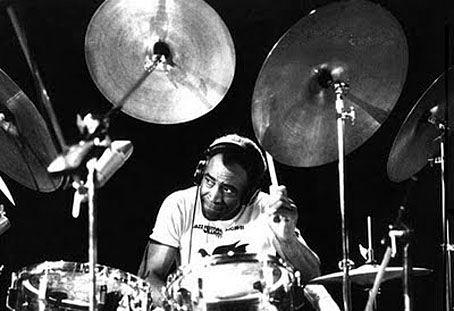
The death this week of guitar pioneer Les Paul is already receiving considerable attention; less will be given to the passing of drummer Rashied Ali. The latter means more for me as a musician since I’m listening to his work all the time. Ali famously (and to some, controversially) replaced drummer Elvin Jones as John Coltrane’s drummer of choice from 1966 onwards, and Ali’s revolutionary free style enabled Coltrane to voyage even further out with his stream-of-consciousness sax playing. Ali’s playing supports all of Coltrane’s later recordings, including their extraordinary duet album Interstellar Space (recorded in the ’60s but not released until 1974). Following Coltrane’s death in 1967, Ali played on a number of albums by the fantastic Alice Coltrane, and while this period inevitably overshadows any appraisal of his work, his career continued to develop to the present day.
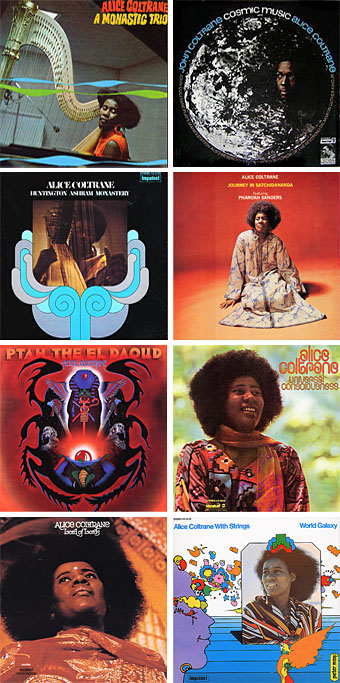
If you’re unused to the “formlessness” of free jazz, Interstellar Space can be a forbidding region until you attune yourself to its rarefied atmospheres. Alice Coltrane’s A Monastic Trio, recorded shortly after her husband’s death, is less challenging and a beautiful tribute to John Coltrane from his wife, friends and collaborators. With Jimmy Garrison on bass, Pharoah Sanders on sax, Alice playing harp and piano, and Ali drumming on five of its six tracks, its a perfect introduction to Ali’s work, and, by extension, to some of the finest music of the last century.
Previously on { feuilleton }
• John Coltrane’s Giant Steps
• Alice Coltrane, 1937–2007