Arrow by The Irrepressibles

arrow.jpg

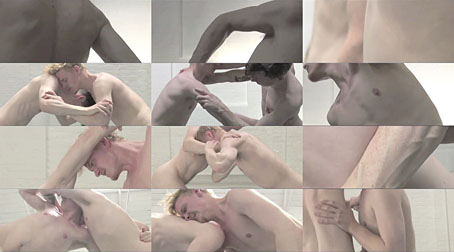
I’ve kept wondering when we’d hear more from The Irrepressibles following the release of their wonderful Mirror Mirror album. Here at last is a new song, Arrow, from a forthcoming album, Nude. Lyrical allusions to Saint Sebastian accompany two naked guys wrestling until…well, go and see. (Thanks to Thom for the tip!)

Directed & choreographed by Jamie McDermott
Camera Person: Kate Perring
Filmed at Studio 7, Alston Works, London.

Previously on { feuilleton }
Los Bikers by Dënver
The Lady Is Dead and The Irrepressibles

Animating Piranesi

dupond.jpg

Piranesi Carceri d’Invenzione (2010).

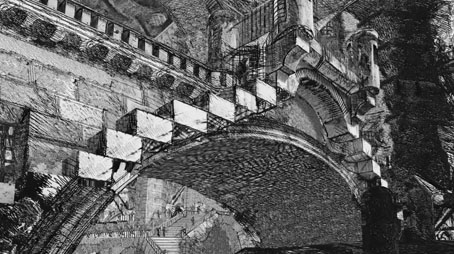
When Peacay at BibliOdyssey linked to this short film by Grégoire Dupond I thought it might be one I hadn’t seen before but it turns out I have, and I mentioned the exhibition it was produced for in 2010. No matter, it’s worth drawing attention to again since Monsieur Dupond makes an impressive job of sending a virtual camera through the vast spaces of Piranesi’s Carceri d’invenzione, joining several of the etchings into a series of contiguous chambers.
yoyoma.jpg

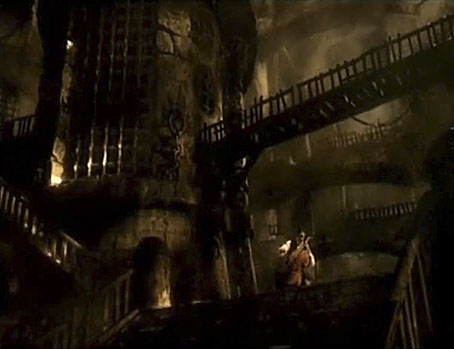
The Sound of the Carceri (1998).

Dupond’s film uses Bach’s Cello Suite #2 as a musical accompaniment. As noted earlier that choice probably came from Yo-Yo Ma’s Inspired by Bach (1998) in which Bach’s six solo cello suites are performed in different settings. Suite #2 was The Sound of the Carceri directed by François Girard which places the cellist inside a CGI rending of one of Piranesi’s Careri etchings. YouTube has a copy here.

Elsewhere on { feuilleton }
The etching and engraving archive

Previously on { feuilleton }
Carceri, thermae and candelabra
La Tour by Schuiten & Peeters
Set in Stone
Piranesi as designer
Vedute di Roma
Aldous Huxley on Piranesi’s Prisons
The Fourth Dimension

fourthdimension.jpg

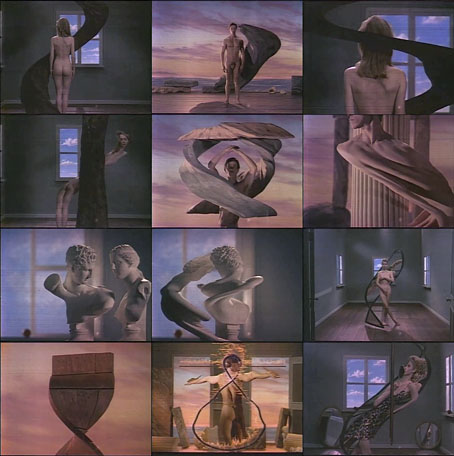
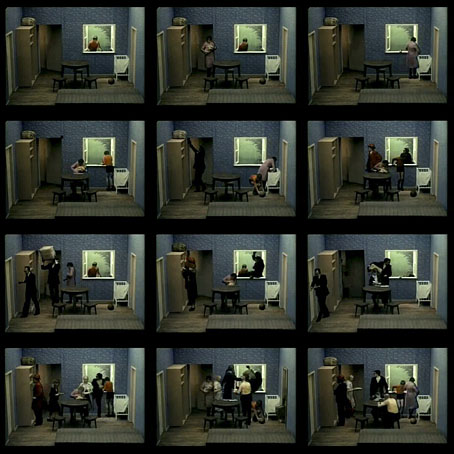
This post ought to have followed the one about Tango since it concerns another experimental film by Zbigniew Rybczynski. The Fourth Dimension was made in 1988 and like many of the director’s films uses a single effect to create striking results. In this case the effect involves photographing people and objects one narrow line at a time. When the lines are combined then shifted slightly the objects seem to bend and twist like melting plastic. This is the kind of semi-analogue technique which has now been made redundant by computer animation but Rybczynski gives his compositions a quasi-Surrealist quality, reinforced by the Magritte-like windows in some of the rooms.

Previously on { feuilleton }
Tango

Tango

tango.jpg

Further film formalism. Tango (1980) by Polish filmmaker Zbigniew Rybczynski is a static shot of an empty room. A boy throws a ball in through the window, retrieves it, exits then throws the ball in through the window. His repeated action is the first of an interwoven series of looped actions by thirty-six different people who eventually form an impossible crowd passing through the room. All human life is here: eating, drinking, sex, death, exercise, breastfeeding, theft, an accident—there’s even a man carrying a toilet bowl. Rybczynski spent seven months doing this the hard way with optical printing which is why the quality fluctuates as the room becomes more crowded. The whole thing lasts eight minutes and you can watch it here.

La Région Centrale

region.jpg

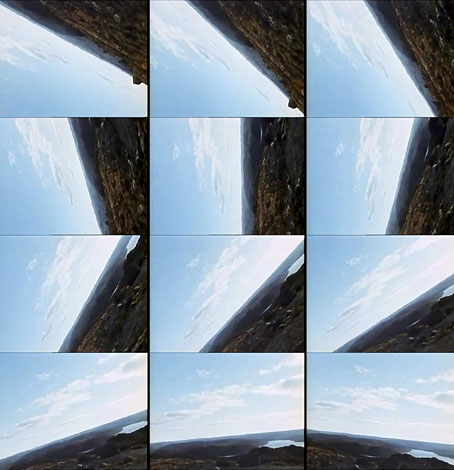
I would have posted this yesterday if it hadn’t been for the news about Ray Bradbury, Michael Snow’s La Région Centrale (1971) and Tony Hill’s Downside Up being related in my head if nowhere else. For anyone interested in experimental cinema Michael Snow occupies a key position with a pair of films that aspire to a kind of epic formality: Wavelength (1967), his 45-minute zoom into a photograph at the opposite end of a room, and La Région Centrale which is shots of the Canadian landscape (and the sky above it) filmed by a continuously moving camera attached to a robotic arm. Since the the latter runs for three whole hours it’s not the kind of thing you’ll find on TV or even at at most arts cinemas. Consequently all I’ve ever seen are extracts like this but it fascinates all the same. The electronic noises are the sound of the camera arm in operation. Snow apparently said that he wanted the effect to be that of an alien probe exploring a new planet; given this you could probably class La Région Centrale as a piece of science fiction formalism along with Chris Marker’s La Jetée.

YouTube is the worst venue for films intended to absorb the viewer’s intention but for the curious there’s a rough copy of Wavelength here.

Previously on { feuilleton }
Downside Up
Expanded Cinema by Gene Youngblood