Strange Attractor Journal Three

saj3.jpg

The wonderful and essential Strange Attractor Journal will be with us again next month.
The previous number (now sold out, I think) included my essay about psychedelic artist Wilfried Sätty.

CONTENTS

Contra Genesis—Catherine Eisner
Unusual cases of extra-genital conception, extra-uterine
gestation, and other anomalous exits.

Burmese Daze—Erik Davis
In which the author submits to the pleasures of a transgender spirit possession festival.

Adventures in the Fourth Dimension—Mike Jay
A Victorian time machine and history’s first theme park ride.

Ego in Exotica Sum—Ken Hollings
In memoriam Martin Denny, crown prince of the exotica sound.

A Psychoactive Bestiary—Richard Rudgley
The joy of zootoxins, from the ant to the giraffe.

Liberté, Légalité, Éternité—David Luke
Some notes on psychonautic misadventures in time.

Kandinsky’s Thought Forms—Gary Lachman
The occult roots of modern art.

Magic Words—Steve Moore
Virgil the Necromancer in mediæval legend.

Abu’l-Qasim al-Iraqi—Robert Irwin
12th century Arab alchemists on the edge
of knowledge.

The Electrochemical Glass—Richard Brown
A slow-evolving artwork from a living alchemist.

The Man Behind the Screen—David Rothenberg
Hans Christian Andersen’s greatest and least-known work.

The Mole of Edge Hill—John Reppion
Joseph Williamson, Liverpool’s tunnelling philanthropist.

La Maison de Poupées—Robert Ansell
A photographic study of a magnificent compulsion.

The Dirty Thirties—Alexis Lykiard
From Arthur Koestler’s Encyclopædia of Sexual Knowledge.

Paint it Black—Stewart Home
Autohagiography of an artist.

Redonda and Her Kings—Roger Dobson
The island life of early science fiction author MP Shiel.

Magic in Paris—Phil Baker
Demons of the opium den in Thirties Paris.

The Dark Man’s Dreams—Doug Skinner
An introduction to Xavier Forneret, Surrealism’s lost poet.

Ghosts: A short Story
by Lady Vervaine.

Plus original artworks by Alison Gill, Josephine Harvatt, Betsy Heistand, Katie Owens, Arik Roper.

Editor: Mark Pilkington.
Print Design: Alison Hutchinson.

Strange Attractor celebrates unpopular culture. We declare war on mediocrity and a pox on the foot soldiers of stupidity. Join Us.

Strange Attractor Journal Three available now from Strange Attractor Shoppe and all good bookshops.

£14 inc p&p by mail order or £13.99 in UK shops.
The art of Shinro Ohtake

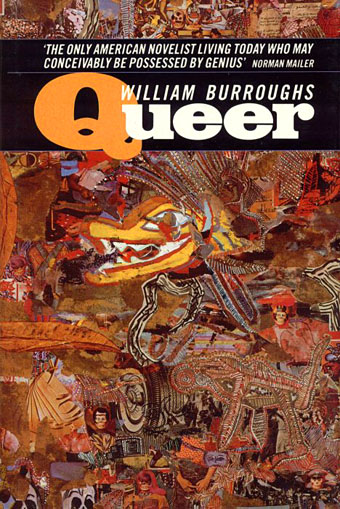
queer.jpg

Shinro Ohtake is always on the attack. Whether it’s against misguided art education, against the cold treatment and economic constraints Japan puts on anyone who could dare to live differently, against the contemporary art establishment that can’t be bothered to even disguise its own incomprehension—his fight as an artist continues. Ohtake is prodigious, original, and a trouble-maker—in the sense that the work of the artist is always to create difference.

William Burroughs

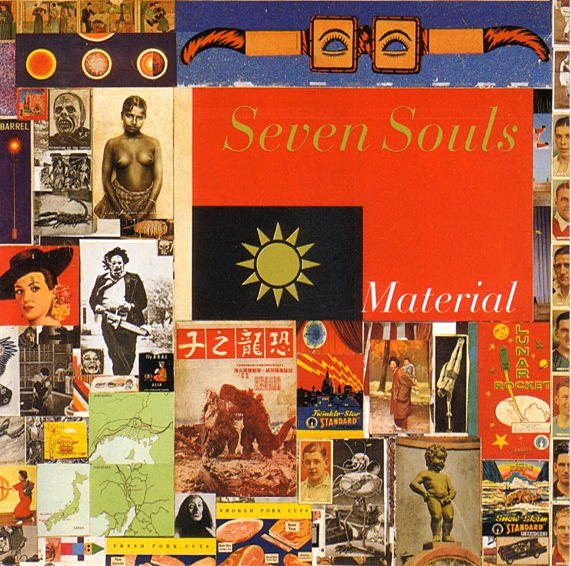
Two disparate things had me looking for Shinro Ohtake‘s work this week: I’ve been doing a short interview about album cover design (more about that at a later date) in which I mentioned his collage for the cover of Seven Souls by Material (1989), then an editorial in the latest Wire describes his current retrospective exhibition at the Museum of Contemporary Art in Tokyo.

seven_souls.jpg

The Material cover is one I picked as a favourite design. It’s difficult trying to pin-point why I think this works so well without it being at all illustrational. (I’m guessing, but it’s likely that Bill Laswell picked it out of one of Ohtake’s collage books, rather than it being specially commissioned.) It may be the collage aspect that works here. The album features readings by William Burroughs set to music and for me is the best of all the Burroughs recordings (Dead City Radio being a close second). Burroughs’ work, of course, involved literary collage via his own cut-up process, and the musical content can also be seen as a collage in the way it mixes different styles and musicians—Simon Shaheen, Shankar, Rammellzee, Foday Musa Suso, Fahiem Dandan and samples of the famous Brian Jones recordings of the Jajouka pipers. It’s a shame that when the CD was reissued in 1997 (in a superior mastering, it should be noted), the original artwork was largely junked in favour of a lot of muddy Photoshop work from the usually excellent Russell Mills. I’ve a huge respect for Mills but this treatment was a serious mistake.

Elsewhere on { feuilleton }
The album covers archive

Previously on { feuilleton }
William Burroughs book covers

Druillet meets Hodgson

hodgson.jpg

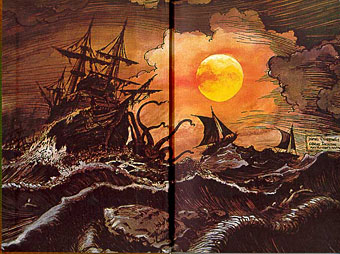
French comic artist and illustrator, Philippe Druillet, illustrates British horror novelist William Hope Hodgson. As anyone familiar with Hodgson’s work knows, this kind of imagery predates Pirates of the Caribbean by nearly a century. More pictures here.

Previously on { feuilleton }
War of the Worlds book covers
The music of Igor Wakhévitch
Le horreur cosmique
Davy Jones

DIY aesthetics

penguin_blank.jpg

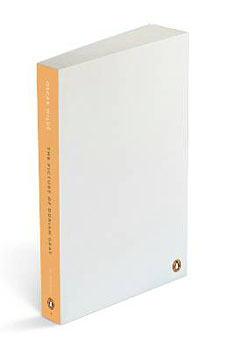
“According to consumer research conducted on what factors matter to people when they decide whether or not to pick up a book in a bookshop, the cover design comes out as most important. So this might be the stupidest thing we’ve ever done.

“…The covers are art-quality paper, and from internal Penguin efforts we know that they hold ink, paint, pencil and glue…. Each one comes shrink-wrapped so the paper doesn’t get dirty, and I hope people might give them as gifts.”

Helen Conford, Senior Commissioning Editor at The Penguin Press.

The latest ploy by Penguin to shift that tricky back catalogue of classics that everyone has heard of but few people read, resorts to what might be called audience interactivity, in other words print a book with a blank cover and the suggestion that the reader draw their own. They’re calling the scheme “My Penguin” which is unfortunate, this has the same treat-me-like-a-child quality as Microsoft’s dreadful “My Computer” and “My Documents”. The new line will be unveiled next week with the following titles: Crime and Punishment by Fyodor Dostoyevsky, Emma by Jane Austen, Magic Tales by the Brothers Grimm, Meditations by Marcus Aurelius, The Picture of Dorian Gray by Oscar Wilde and The Waves by Virginia Woolf.

This is a rather more interesting idea than Headline’s repackaging of Jane Austen as Georgian chick-lit earlier this year, a move guaranteed to disappoint anyone expecting Helen Fielding in period costume. Penguin is asking readers to send in their designs which they’ll then feature in an online gallery. In a way this goes against the traditional function of the paperback which serves as a cheap(ish), easily portable object that’s often treated with considerable disrespect while being used. Anyone who spends a couple of hours crafting their own cover design will quickly find they have a bespoke art object in their home that they want to preserve, not bend out of shape during the morning commute then discard when finished. It’ll be interesting seeing how this project develops. Will many of these unique designs turn up later on the Oxfam shelves along with all the other secondhand volumes, or will people want to keep them? Will we start seeing dedicated collectors of these titles and their artworks? (Some will no doubt be worth a great deal of money in the future if the cover is drawn by a famous owner.) And some are easier to illustrate than others; everyone knows the story of Dorian Gray but what would be suitable for Marcus Aurelius, for instance?

Elsewhere on { feuilleton }
The book covers archive

Previously on { feuilleton }
The Picture of Dorian Gray – I

William Burroughs gives thanks

Lest we forget…

burroughs.jpg

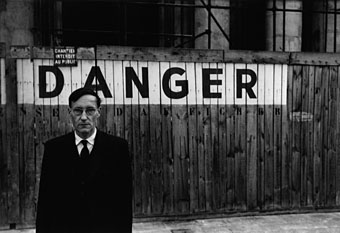
William Burroughs.

Thanksgiving Day, Nov. 28, 1986.

For John Dillinger
In hope he is still alive

Thanks for the wild turkey and the Passenger Pigeons, destined to be shit out through wholesome American guts —

thanks for a Continent to despoil and poison —

thanks for Indians to provide a modicum of challenge and danger —

thanks for vast herds of bison to kill and skin, leaving the carcass to rot —

thanks for bounties on wolves and coyotes —

thanks for the AMERICAN DREAM to vulgarize and falsify until the bare lies shine through —

thanks for the KKK, for nigger-killing lawmen feeling their notches, for decent church-going women with their mean, pinched, bitter, evil faces —

thanks for “Kill a Queer for Christ” stickers —

thanks for laboratory AIDS —

thanks for Prohibition and the War Against Drugs —

thanks for a country where nobody is allowed to mind his own business —

thanks for a nation of finks — yes,

thanks for all the memories… all right, let’s see your arms… you always were a headache and you always were a bore —

thanks for the last and greatest betrayal of the last and greatest of human dreams.• From Tornado Alley (1989).

Previously on { feuilleton }
William Burroughs book covers
Towers Open Fire