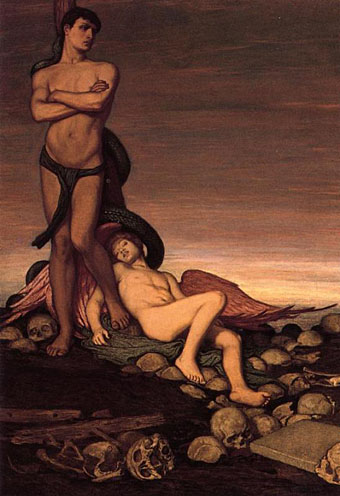
The Last Man (1886–1891).
Vedder was one of the principal American Symbolists, possibly the leading one although there wasn’t the same degree of competition in the United States as there was in Europe. Last time I was casting around the web for his work he wasn’t so visible but that’s changed recently with a dedicated website. Vedder’s 1884 edition of the The Rubáiyát of Omar Khayyám is highly-regarded and at least one of those drawings—The Cup of Death—was reworked as a painting. Compared to his Continental contemporaries he’s a particularly gloomy artist, with sombre subjects rendered in a sombre palette. The Last Man is typical as well as being curiously inexplicable; is the serpent there a Satanic presence? And why is there a dead (?) angel boy at the feet of the Last Man?
The Smithsonian American Art Museum has a set of the Rubáiyát illustrations.
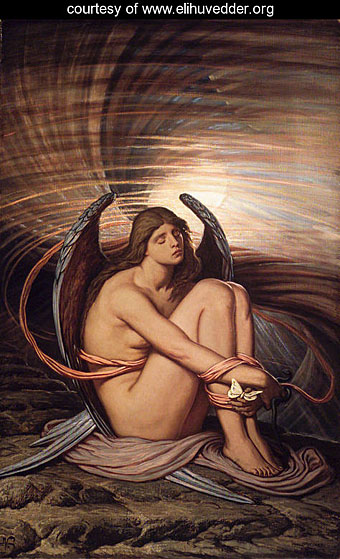
Soul in Bondage (1891–1892).
Previously on { feuilleton }
• Angels 5: Angels of Death
Thank you, I’d no idea he painted – Listening to the Sphinx, which is one I’ve always liked, though I’d never known the title either. It certainly makes sense though.
That’s one of the few I’d seen before. Surprising to see another version of it.
Love Vedder. Love those Symbolists. Love you!
Heh, thanks Thom!