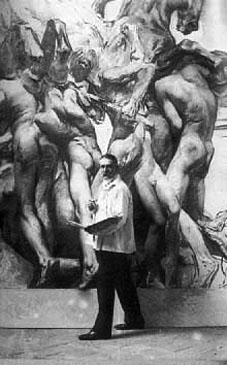
Giulio Aristide Sartorio is generally counted as one of the Italian Symbolists, along with painters such as Giovanni Segantini. He’s also one of the few notable artists of the period to have worked as a film director.
I’ve been fascinated by the curiously erotic academic style of Sartorio’s early work for years but these paintings rarely appear in books (although there have been a couple of monographs) and there’s little decent attention given to him on the web. Philippe Jullian in his essential guide to Symbolism, Dreamers of Decadence (Pall Mall Press, 1971), describes his work as being “vast paintings… full of handsome warriors who are always naked and generally dead.” Gabriele D’Annunzio, who knew heroic camp when he saw it, became a fan when the pair met in Rome in the 1880s. Sartorio illustrated D’Annunzio’s Isaotta Guttadàuro in 1886 and they continued to collaborate into the 1920s. One possible reason for Sartorio’s falling out of favour may have been later association with Mussolini’s Fascists, something else he shared with D’Annunzio.
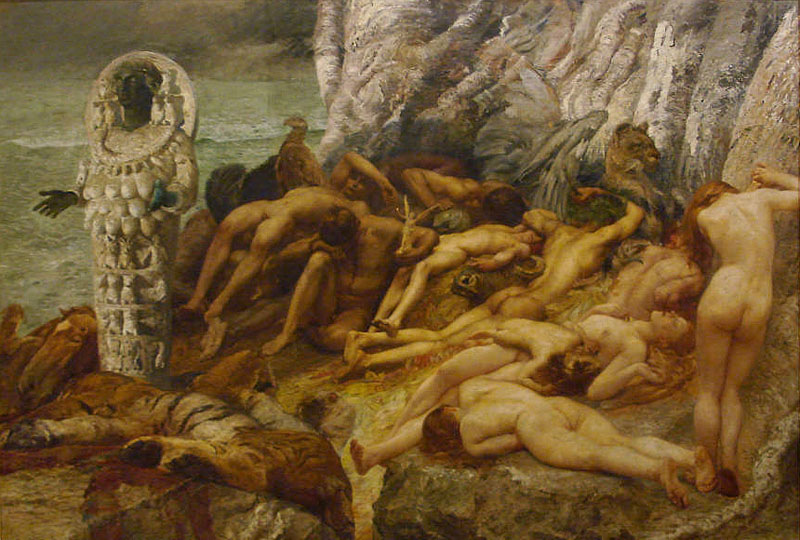
Diana of Ephesus and the Slaves (1893–98).
Much as I’d like to point you to a large reproduction of the bizarre Diana of Ephesus and the Slaves, there doesn’t seem to be one around just now. However, you can see a few gallery pages of Sartorio’s work here if you don’t mind the copyright label spoiling everything.
Update: A reasonable copy of the Diana painting has turned up. Click the image above.

Diana of Ephesus and the Slaves (detail).

Gorgon and the Heroes (1895–99).

L’Invasione degli Unni (no date).
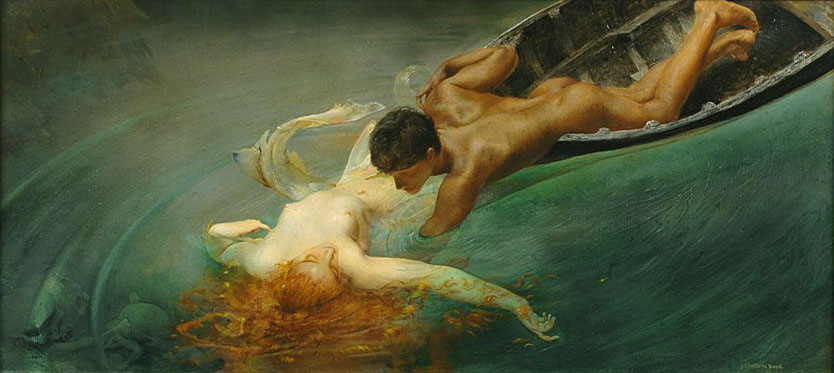
Siren or The Green Abyss (1900).
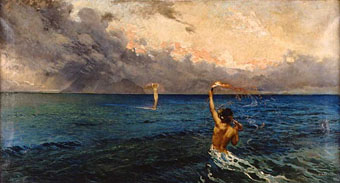
Pico, roi du Latium, et Circé de Thessalie (1904).
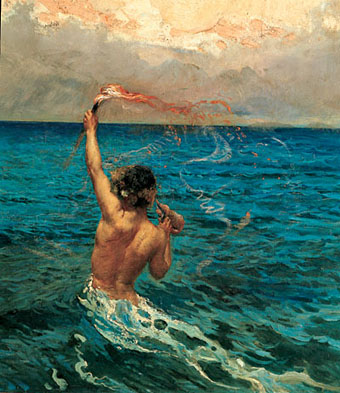
Pico, roi du Latium (detail).
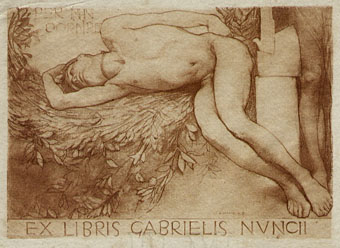
Ex libris Gabrielis Nuncii “per non dormire” (1906).
Elsewhere on { feuilleton }
• The gay artists archive
Previously on { feuilleton }
• Angels 4: Fallen angels
There was a wonderful exhibition on Sartorio last year, in Chiostro del Bramante and I discovered this painter, whom I had never heard of before. i should have known (by now) that you would have liked him too…
It was truly enchanting (the reproduction here does not do credit to the vibrant colours of “Pico, Re del Lazio” by the way : I got so mesmerized by it that I had to get myself the postcard – sadly, there was no catalogue for the show).
The ink works (a lot of ex libris) that were presented were also very good but the painter seem hardly known outside Italy. He has done the frescoes on the Parlement ceiling too.
Ack, now I’m jealous! I found a lot of references to that exhibition while searching for these pictures. Nothing for it now but to see if I can track down some of the books about him.
I went in to look at the LiveJournal post I had made about that exhibition and I had put a link to the site, link that I know expected NOT to be working anymore since I could not find an archive on the Chiostro’s page.
However, much to my surprise, it DOES still work so you can have a look at a few paintings:
http://spacedlaw.livejournal.com/919.html
(Oh and if you scroll down the comments, you will see another painting from another show that enchanted me last year, that of Jiang Guo Fang.)
Oh, I did look at that site but didn’t persevere with my search there. A shame they don’t have more pictures but I’ve lifted their detail from the Pico, Re del Lazio.
The Jiang Guo Fang is a painting? Wow.
Wow exactly.
They were vibrant with colours and amazing details, and the artist used a camera obscura or photography to prepare his paintings, something that Sartorio also did (being a pionneer in that respect).
It was a bit like looking at the movie “The last Emperor”.
And this time, the exhibition HAD a catalogue.
I remember hearing a lecture on Greek lifestyle touch on the goddess in the top picture, and how, in whichever city-state her cult was most concentrated, they had rigged fountains in temples using her likeness as the headpiece and that each of her nipples would spew forth milk rather than water during the climax of celebrations.
For obvious reasons they would never leave her statue-fountains on for very long.
There’s a great Sartorio picture in the Vatican Museums, as well as that Diana of Ephesus statue (or a copy of it). Just seen them both while on holiday.
http://it.wikipedia.org/wiki/Giulio_Aristide_Sartorio is useful if you can read Italian.
My mother was given two paintings of Giulio Aristide Sartorio that were painted in the 1920’s when during “The voyage of the ship ITALIA” when 40 cities were visited in 12 Latin-American countries, with the aim of prmoting Italian culture. Sartorio took part in the voyage as commisry of the government fo the artist part.
The Vicolo dei Catinari exhibition displays ” some of the more striking landscapes” painted by Sartorio in Latin America.
The two paintings I have are of llamas and a storm sept scene.
I would love to know there value. Any info appreciated.
Hi Joan. You’d have to ask an art dealer for that kind of specialised information. Or you could try one of the many art sites such as Artnet.com. Most of them seem to require free registration but once you’ve registered you can find details about previous art sales for a variety of artists.
Just uploaded a scan of the version of ‘Diana of Ephasus’ from Jullian’s ‘Dreamers of Decadence’ book here:http://www.flickr.com/photos/nickhydra/6959256040/.
I first came across this image on the cover of the fabulous UK Decay single ‘Sexual/ Twist in the Tale’. http://thep5.blogspot.co.uk/2009/10/uk-decay-sexual.html
They (or the person who did their designs) obviously had the book as well, as their LP cover is Toorop’s ‘Disintegration of Faith’: http://cactusmouthinformer.blogspot.co.uk/2009/10/uk-decay-tidy-up.html
This band and their design style are entirely responsible for my interest in Symbolist/ Decadent art. Funny how everything good in my life always comes back to punk rock…
you can buy a print here:
http://shop.alinari.it/en/product-details-43173